Friday, 15 July 2016

WE ARE IN A DITCH DOLLS!


If ever there was proof that God has a sense of humour it was when I was ordained to priesthood. When I hit the half century mark Church wasn’t on my bucket list, I was saving for a world cruise on the QE2. God was more likely to be mentioned when I stubbed my toe and Jesus didn’t really appeal other than to discuss whether he and Mary Magdalene had had sex.

Nonetheless, as I began attending services at St Martin’s-in-the-Veld, Joburg, I had that ‘new convert’s’ romantic perception of religion and clergy. Probably a hang-over from my convent boarding school days when the only posters we stuck on our walls were of the pope and various saints.


So I was quite shocked when a woman who had dealings with the higher echelons of the Anglican Church in Southern Africa made disparaging remarks about clergy who “slept around” and “reallocated” funds.

It was the best thing that could have happened to me.

With my rose tinted glasses relegated to the dustbin and a healthy dose of cynicism I came to understand that Church is, at best, a messy organisation – a peculiar balance of humanity at its best and its worst. If you are looking for miracles, look no further than your nearest parish and how it has survived personality clashes and varying levels of competence, humility and servanthood.

Ignorance is
But the years passed and I’ve been jogging along with a sense of ‘knowing the Church’.  Then the One with the quirky sense of humour had yet another belly laugh as I began writing my mystery series.   Having worked as Archbishop Njongo’s media liaison person for seven years and been a Susan Howatch fan, my first novel was inevitably set within Church. The main protagonist is a former PR guru testing a calling to a monastic vocation but who has to solve a couple of murders with the help of the folk running the agency.  Alec Fergusson is white middle aged and a doddle for me to write about.

A strange thing
Then, as I began the next novel, a strange thing happened. Alec began taking a back seat as Archbishop Shakes Khumalo assumed centre stage. At first I wasn’t too bothered. After all I’d spent many years within the ANC, I’d trained for priesthood in Soweto, I’d worked for Archbishop Njongo. It also helped that Shakes spent several years in the UK where he studied Law.

Of course I could write from a black archbishop's perspective.

But as Shakes drew me into his worldview I came to understand how much I still have to learn. How patient my black friends and associates have been with me all these years and why I have to rely on black editors to help keep Shakes credible.

There’s no turning back. The series belongs to Shakes and its meant to be a fun read. But against the backdrop of the #blacklivesmatter vs #alllivesmatter debate and at a deeply personal level, I know that I have to dig ever deeper into his world.  Not because it will make him more credible but because I must.

A wake up call
My unease increased when I shared this Facebook post,


and a dear friend responded ‘Black lives matter’.

That brought me up short.

The following morning at around 4:27 I watched a CNN interview with Dr Brian Williams, the black trauma surgeon who had treated the Dallas policemen shot during a Black Lives Matter protest march.  

Emphasising that he didn’t want to detract from the pain of the slain officers’ families, Dr Williams told how he too feared for his life outside the hospital. He spoke of the need for more open discussion about race. “How can we understand each other better,” he asked. “We need to stop talking over each other, to truly listen to the other side, to not shut each other out.”

Other interviews followed and, as the slow winter dawn stretched across Kommetjie, I came to understand that until and unless we erase the vulnerability of and dehumanisation of black people, all lives can’t matter.

As with all cataclysmic events an iconic picture emerges. My bet is that this is the one that will epitomise the Black Lives Matter movement.


Facebook user R. Alex Haynes posted: “This is my best friend that I have known since we were 8 (20 years now). “Her name is Leshia and she has a 5-year-old son. She went to Baton Rouge because she wanted to look her son in the eyes to tell him she fought for his freedom and rights. They haven’t released her as of yet but she’s fine.”

Hopefully, the US discussions on racism will spill over into South Africa where the sin of differentiation and privilege bubbles and boils.

Where is Church in all this?
The Anglican (Episcopal) Church in Southern Africa has transformed, If I’d made Shakes white, he wouldn’t have been credible.  But I am acutely conscious of the cringe-worthy unconscious racism that still exists among clergy and laity alike.  It’s a spin-off of privilege, the sense of white is right and better. (Anyone tried to introduce choruses in a traditionally white parish lately?  ever wondered why so few black parishioners serve on committees?)

Of course there are exceptions but, while we Anglicans don’t usually  sink to the depths of the preacher from another denomination who told his congregation that white people were better off because they work harder, we have at many levels yet to truly listen to each other. To respect each other. To see God in each other.


Because I haven’t made the Shakes series a soapbox for racism it is in the detail of his life that I am made aware of his daily realities. The white suffragan bishop who disapproves of any efforts to “Africanise” the Church. The difficulty he has in dealing with an apartheid era security operative and his guilt for abandoning his Sowetan boyhood friends on his journey to success – first as an advocate and then as a church man.

Yet again, God has nudged me out of my comfort zone.

Not the Samaritan
I felt this as I preached on the Good Samaritan last Sunday. I’d filled an emergency pulpit gap and was relieved to find it such an easy reading. But no matter how I leaned on past interpretations this nagging voice kept saying “it’s about being in the ditch.”  I realised that for too long I’d viewed myself, my congregants and my Church as the Samaritan – duty bound to minister to those in need and less privileged.


The Revd Dr Marcia Mount Shoop

In the US the Revd Dr Marcia Mount Shoop, preached that same day on the same reading at the Grace Covenant Presbyterian Church in Asheville North Carolina .  A consultant, author, and theologian who focuses on healing and spiritual growth around issues of violence, race, power, privilege and loss, she was far more eloquent than I was in Ocean View Cape Town.

A moral ambivalence
Addressing white supremacy and the moral ambivalence of white dominant institutions around race and power question she urged, “Brothers and sisters in Christ, we are at a crossroads as a nation and as a faith. The road behind us is washed out—we cannot go back, we cannot un-see what we have seen, we cannot deny the blood on our hands, we cannot deny the moral ambivalence around the very category of full humanity that rests at the foundation of our most hallowed institutions—our justice system, our education system, our government, our economic system, and yes, even the church.”

She spoke of how duty is an attempt to tidy up the ambiguity of our human situation. “And while our human minds like simple, clear, non-negotiable answers to life’s most complicated questions, ambiguity abides—and calls us to a deeper place from which to define our morality, our responsibility, indeed our humanity. Far deeper than our learned reflexes of duty is our blood chilling vulnerability: mine, yours, ours.”

Snoop elaborated, “And while the normative culture of mainline Christianity has taught us the language of helping the “least of these,” white culture, white patriarchal culture has told us lies: that we can somehow secure our safety, our well-being on the backs of others and make ourselves less vulnerable than everyone else. As white dominant institutions, Mainline churches have not often considered our own profound vulnerability.

“What if we are not the Good Samaritan? What if we are naked, barely conscious, and beaten within an inch of our lives on the side of the road? ….. What if being Jesus followers is less about being the one with the power to help and more about telling the truth of just how vulnerable we really are? This is not duty. This is not pity. This is our humanity.

“White culture has distorted our shared humanity and our full humanity because it formed us with an expectation of safety and self-protection. White culture has tried to tell us we can erase our vulnerability, our grief, our fragility, our uniqueness, our idiosyncrasy—and from this attempted erasure we have learned repetitive, dehumanizing habits. We are habituated to ask “How can we help?” But rarely do we ask, “How can we change? How can we be the change?”

“White supremacy is a powerful demon that must be exorcised. This does not mean all white people are bad, this means the culture spawned by white supremacy is a disease that afflicts us all—it permeates our instincts, our muscle twitches, our gut reactions, our intimacy, our self-understanding. Jesus, help us, help us not be afraid to tell you the truth of our affliction.”

For her full sermon go to: http://ow.ly/bwPj302gNlI

Or maybe we should all simply watch this 14 year old white boy's You Tube video:
http://ow.ly/QNpX302h0tI

Friday, 29 April 2016

A DOSE OF HOLINESS FROM AN ARCHBISHOP CONCEIVED IN A DRUNKEN COUPLING

A healthy dose of reality
The recent revelation that our Anglican Archbishop, Justin Welby, is the illegitimate son of Sir Anthony Montague Browne has all the ingredients for a global scandal. After all, it has elements of sex, booze, high society, beautiful women, political power and religion. Yet the public face of some 77 million Anglicans worldwide has deftly deflated the story by resorting to good old fashioned honesty and, yes, holiness.

Lady Williams


Honesty is the best policy
For starters, his 86-year-old mother, a recovering alcoholic who hasn’t touch a drop in decades, deftly took the wind out of the yellow-press sails.  Lady Williams of Elvel, a former magistrate and a deputy lieutenant for Greater London, said in an interview: “Naturally, my son has deserved an explanation and I have been as open as I can.”


She went on to reveal that, “fuelled by a large amount of alcohol on both sides”, she and Sir Anthony had slept together only days before her “very sudden marriage” to Gavin Welby, a whisky salesman with social aspirations.

Because our archbishop was born nine months after that wedding he was presumed to have been a honeymoon baby. So mother and son would have been shocked by the paternity news but there was no attempt by either to dodge the issue.

An uncomplicated response
The Telegraph broke the story and a senior journalist reveals that, when he approached the archbishop with circumstantial evidence that had been garnered, Justin Welby’s uncomplicated reaction was “why don’t we do a DNA test?’  A saliva swab was taken from inside his cheek.

Lady Montague Browne, Sir Anthony’s widow and a former personal assistant to Churchill’s wife, readily produced a hair from her deceased husband’s hairbrush for the other half of the DNA test.


It appears that she had long suspected that he was Justin Welby’s father.  She told The Telegraph that, many years earlier, her then husband had teasingly said: “I’m told I have a son… you’ll find out one day.”

Moreover, when Archbishop Justin’s appointment was announced her son from a previous marriage (seems the aristocracy and Elizabeth Taylor have multi-matrimony in common) began discussing with Sir Anthony how uncannily alike they looked.

Sir Anthony Montague Browne

The old man was in a care home at the time and they spoke in French to avoid being overheard.

Separately, Jane Hoare-Temple, the daughter of Sir Anthony and his first wife, Noel, had concluded that there must be a family connection because the Archbishop was “the spitting image of my father”.  (Add a half-sister to the already interesting equation)


Archbishop Justin Welby

True leaders don’t duck
It all makes for a great story but I believe history will underscore the archbishop’s response rather that the juicy gossip.

I’ll treat you to his statement in full:-

In the last month I have discovered that my biological father is not Gavin Welby but, in fact, the late Sir Anthony Montague Browne.

This comes as a complete surprise.

My mother (Jane Williams) and father (Gavin Welby) were both alcoholics. My mother has been in recovery since 1968, and has not touched alcohol for over 48 years. I am enormously proud of her.

My father (Gavin Welby) died as a result of the alcohol and smoking in 1977 when I was 21.
As a result of my parents’ addictions my early life was messy, although I had the blessing and gift of a wonderful education, and was cared for deeply by my grandmother, my mother once she was in recovery, and my father (Gavin Welby) as far as he was able.

I have had a life of great blessing and wonderful support, especially from Caroline and our children, as well as a great many wonderful friends and family.
My own experience is typical of many people. To find that one's father is other than imagined is not unusual. To be the child of families with great difficulties in relationships, with substance abuse or other matters, is far too normal.

By the grace of God, found in Christian faith, through the NHS, through Alcoholics Anonymous and through her own very remarkable determination and effort, my mother has lived free of alcohol, has a very happy marriage, and has contributed greatly to society as a probation officer, member of the National Parole Board, Prison Visitor and with involvement in penal reform.

She has also played a wonderful part in my life and in the lives of my children and now grandchildren, as has my stepfather whose support and encouragement has been generous, unstinting and unfailing.

This revelation has, of course, been a surprise, but in my life and in our marriage Caroline and I have had far worse. I know that I find who I am in Jesus Christ, not in genetics, and my identity in him never changes. Even more importantly my role as Archbishop makes me constantly aware of the real and genuine pain and suffering of many around the world, which should be the main focus of our prayers.

Although there are elements of sadness, and even tragedy in my father's (Gavin Welby’s) case, this is a story of redemption and hope from a place of tumultuous difficulty and near despair in several lives. It is a testimony to the grace and power of Christ to liberate and redeem us, grace and power which is offered to every human being.

At the very outset of my inauguration service three years ago, Evangeline Kanagasooriam, a young member of the Canterbury Cathedral congregation, said: “We greet you in the name of Christ. Who are you, and why do you request entry?” To which I responded: “I am Justin, a servant of Jesus Christ, and I come as one seeking the grace of God to travel with you in His service together.” What has changed? Nothing!

Cheated by death
Sir Winston Churchill

Father and son had met  within the Churchill circle. when Archbishop Justin was still a boy. Poignantly, when the archbishop was appointed in 2013, his father asked to see him but died ­­­­­­before that could happen.

Sir Anthony Arthur Duncan Montague Browne KCMG CBE DFC was a decorated war time pilot and diplomat who was private secretary to Sir Winston Churchill for the last ten years of the latter's life.

Gavin Welby, who died of a heart attack in 1977, also served in the Second World War but later “promoted” himself from lieutenant to captain A social climber, he’d changed his name from Weiler to Welby and dated John F Kennedy’s sister Pat as well as the actress Vanessa Redgrave. The Gatsby-like character stood for the UK Parliament twice and never revealed a short-lived marriage to an American heiress.

The archbishop would later describe him as “a complicated man” but “really, really brilliant”. Notably, he honours Gavin Welby in his statement and once remarked that if his presumed father had been honest about his life, it would have been “a fantastic story” of overcoming setbacks.

Two very different ‘fathers’. No doubt our archbishop is the sum of both parts and I love how real he is.


Lessons in identity
It appears that he hinted at the dramatic revelations to come when he spoke in Zambia to a gathering of young people from across Africa  two days before the news broke.

Addressing the question of personal identity on the eve of the Anglican Consultative Council meeting, he told them: “We need to be a church where I am who I am because I am in Jesus Christ. That’s the only thing that gives me identity and you will see why I am saying that in a couple days’ time."

Since that dramatic disclosure Archbishop Welby has been widely praised by faith leaders, Coptic, Jewish and Catholic alike for the dignity, grace and forgiveness with which he greeted the revelation.

For my part I’m immensely relieved that the Church scrapped the rule that barred an illegitimate man from becoming archbishop. That particular Canon was around for hundreds of years so perhaps there is hope for a couple of others to be trashed.

I also know that by simply writing this blog I have not only been alerted to several potential sermons on identity, I have a glimmer of hope that the example of compassion will take us on a journey of love towards  greater acceptance of political refugees and our  LGBT brothers and sisters.

Friday, 25 March 2016

OF SCAPEGOATS, MEL GIBSON AND THE DONALD


We Christians have a knack for giving biblical personalities a bad press, or, at best, distorting their bios to suite our own agendas. We brand God as loving and forgiving while wielding the Scriptures much like the Pharisees who Jesus consistently exhorted us not to emulate. We peg our scapegoats and never let them go. It feeds our smugness.

For example, at this time of the year we contemplate the crucifixion– all too often like voyeurs at a motor accident. Soon after that we focus on Jesus’ re-appearance to his apostles. Pivotal to those narratives are Judas Iscariot (think greedy traitor) and Thomas (think doubter).


Judas has had a particularly bad press but it can be argued that there was much more to that infamous kiss than 30 pieces of silver.


Firstly, as the Jews suffered under Roman oppression their vision of a Messiah had little to do with heaven. The afterlife didn’t feature as powerfully as their worldly hardships and they were anxiously waiting for their very own ‘Che’ Guevara to overthrow their rulers.


Enter Judas who, it seems, was a passionate revolutionary probably growing impatient with Jesus’ dis-inclination to lead a political uprising. Well aware of Jesus’ miraculous powers (as in sticking an ear back after it had been chopped off by a sword), it was highly unlikely that he believed he was sending his leader to his death. His intention was simply to nudge Jesus into action. The man he had watched raise the dead and heal the sick could surely dethrone Herod and zap the Romans?

That kiss was a classic case of a plan gone wrong. Was Judas’ suicide akin to falling on one’s sword in other honour cultures?

There’s yet another factor. By classifying Mr Iscariot as the arch betrayer we paint Jesus as a victim. It’s the ultimate insult or do we find a gentle Jesus, meek and mild, easier to manipulate for our own purposes?

Yet, John’s gospel presents Jesus as being in full control of the situation from the Judas kiss to his last breath on the cross. The reasoning is that Jesus allowed those awful events to flow in order to live out the Messianic prophesy. The proof sits with the resurrection.


I suspect even Donald Trump would agree that power over death far outweighs political power.

On that basis Judas simply served Jesus’ purpose. But do we give him an iota of sympathy? No ways!

We’ve done such a good job of making him synonymous with betrayal that he is linked to one of the most famous rock and roll heckles of all time. It was 1966 at a concert in England that, as Bob Dylan switched to an electronic guitar an outraged member of the audience yelled “Judas!”


Dylan’s love for his new electric instrument was viewed a blasphemous.

That story would not have gone down in the annals of music history if we Christians had been less condemning of  Judas. When he planted a kiss on his rabbi’s cheek after three years of faithful following, he was branded for ever. One can just imagine how quick the other disciples were to condemn, despite their own failings.

No one really knows what drove Judas. But, for sure, we Christians have judged and sentenced him mercilessly to our lectionary of derogatory terms.


Thomas is also much maligned. We’ve made him a synonym for doubt, particularly doubt in God, lack of faith. 


For starters nobody seems to notice that Jesus doesn’t reprimand him for doubting the resurrection. He simply seeks to reassures the disciple by inviting him to check out the crucifixion wounds. (No fuss, no rant. Just as nobody ever seems to notice that Jesus doesn’t criticise the woman at the well for the men in her life. He doesn’t even instruct her to leave the man she is living with.) But we Christians have an awful tendency to look askance at folk who have difficulty believing in God.

For heaven’s sake! Justin Welby, the Archbishop of Canterbury, has shared that sometimes he doubts. I know I do. Many of my Anglican friends grew up confident that God exists, they have absolute confidence that their guardian angel hovers and Jesus loves them. It’s not that easy for me. I have to work at my faith.

Sometimes I have to work extra hard but I do take comfort from Mother Theresa who wrote in her private journals that she lived much of her life not feeling God’s presence.


In fact, I was only ready to place my chips on the roulette wheel of faith when reading Gerard Hughes God of Surprises at the grand age of 50. He helped me understand that I could not intelectualise God, God wouldn’t be God and my best bet was to get on with the game.

My spiritual journey will always involve potholes of doubt. But that’s okay. It’s part of my human condition and its never boring.

Another incredibly valuable lesson I learned for Father Gerry is not to confuse God-incidences with coincidences. As I prepare to launch the first in my Archbishop Shakes mystery series, I’m experiencing a major one. Besides a lot of grind, the book has inched forward against a backdrop of many arrow prayers for help.

In the short cul de sac I live in there is a friend on the opposite side of the road who edits non-fiction books and was an excellent beta reader for the novel. My neighbour on one side is an IT specialist who has helped me set up social media platforms, websites, blogs and all the other stuff one has to do when self-publishing. On the other side is a couple of graphic artists who are designing my cover. A stone’s through down the road is a friend who is a professional editor. Add to that all the other friends who have read the book to check for errors and know that there is one big God-incidence happening.


But, back to Good Friday for a moment. Do you remember the Mel Gibson movie called The Passion of the Christ? It grossed millions of dollars. Christians across the globe packed cinemas. Gibson, a conservative Catholic, brought home the sheer brutality of what Jesus went through.

Even now, 12 years later, if I meditate on the gruesome events, scenes from the movie spring to mind. The blood, the cruelty, the suffering. It worries me that too many of our Good Friday services assume a morbid overtone that isn’t healthy. I think we work too hard at blocking out the joy and promise of the resurrection. It’s too much like self-flagellation. I don’t think Jesus went through that ordeal for us to beat ourselves up about it, surely the whole point was to draw us into a joyous mystery?


Another lasting impression I got from the movie was of the fine donkeys. (Not sure if they were Hollywood manicured and blow dried or the genuine Jerusalem breed.)

I’d always imagined Jesus riding into the Holy City on the kind of asses we see in the rural areas of South Africa. But the animals that starred in The Passion, especially around Herod’s court, were truly impressive. 


I tried to source photos from Google by typing in ‘donkeys, Mel Gibson movie’ nothing came up so I tried ‘asses, Mel Gibson movie.’ Guess what it gave me? On second thoughts, let’s not go there.

Tuesday, 23 February 2016

INCREDIBLY HUNG UP ON SEX


Why do Christians flip at any suggestion that Jesus and Mary Magdalene may have been an item? Why did the nuns who taught me throughout my school years cultivate the myth that Jesus was an only child? Was it because, heaven forbid that Mary should have had sex with the long suffering Joseph? (I was 50 years old when I realised Jesus had siblings.) 


Not a sibling in sight
What was the biggest unspoken question when Pope John Paul II’s letters, spanning 32 years, to a married woman were published? In my book, if he did have an oops with the beautiful Polish philosopher he deserved to be Ssainted for sticking with his vocation and serving a broken world.

SECOND COUSIN TO SIN
Fact is we Christians are incredibly hung up on sex, too often declaring it second cousin to another three-letter word – sin. Notably the heroines in our religious traditions are either virgins or reformed prostitutes. There is no middle ground. Too often we fail to take the measure of sexuality within the context of God’s plan for humankind.

Professor Dr Riffat Hassan, a Pakistani-American theologian, notes that human sexuality has been much debated in most religious traditions, including those of Judaism, Christianity and Islam. 


However, while the Jews and the Muslims regard being sexual as good and certainly not the opposite of spirituality, in our early tradition we even regarded sex within marriage, as a necessary evil! 


I paraphrase from Prof Hassan’s contribution to Behold, I make all things new, a book I recently co-edited.

The Qur’an encourages all Muslims who are able and willing, to marry a ‘virtuous’ or ‘chaste’ man or woman. Marriage is viewed as a sign of God’s mercy and a most solemn and serious pledge.

Traditional Judaism views marriage as a contractual bond commanded by God. A man and a woman come together and create a relationship in which God is directly involved (Deuteronomy 24:1).

GRUMPY OLD MEN

But in our early tradition celibacy was viewed as the prime Christian vocation. Paul didn’t think there was any point in saddling oneself with a spouse because he believed Jesus’ return was imminent. Although we must give grumpy Paul his due, he did say it was a personal opinion.


St Augustine didn’t make things easier. He taught that, while sex in the Garden of Eden had been good and rational, the grand Fall turned it into a mindless, bestial enjoyment. A sin that held us back from the contemplation of God.

As Karen Armstrong, eminent historian of religion, points out, his doctrine of original sin would fuse sexuality and sin indissolubly in the imagination of the Christian west. For centuries this tainted the institution of matrimony. Augustine’s teacher, St Ambrose of Milan, believed that ‘virginity is the one thing that keeps us from the beasts’. The North African theologian Tertullian equated marriage with fornication.

St Jerome wrote, ‘It is not disparaging wedlock to prefer virginity. ‘No one can compare two things if one is good and the other evil.’ (I kid you not)

IT GETS WORSE


Martin Luther, who left his monastery to marry, inherited Augustine’s bleak view of sex. ‘No matter what praise is given to marriage,’ he wrote, ‘I will not concede that it is no sin.’ (Nonetheless he and Katharina, a former nun, did produce six children.) He regarded matrimony as a ‘hospital for sick people’ which merely covered the shameful act with a veneer of respectability, so that ‘God winks at it.’

It wasn’t until the 16th Century that Frenchman, John Calvin, became the first western theologian to praise marriage unreservedly. Thereafter Christians began to speak of ‘holy matrimony.’

In short, the present enthusiasm for ‘family values’ is relatively recent. Mind you Catholic priests and gay Anglican priests are still required to be celibate. And the Catholic ban on artificial contraception implies that sex is only for making kids.

SEX CAN BE SPIRITUAL
Yet it was the Catholic Cardinal Basil Hume who wrote, ‘every experience of love gives us yet another glimpse of the meaning of love in God himself. Human love is the instrument we can use to explore the mystery of love which God is.’

Of course there is loveless sex but, let’s face it, sex between two people who do love each other can be glorious. A hymn to our Creator.

Needless to say, passion is fueled by obstacles – the basis of the world’s most famous love stories. 


Throw a priest in the mix and you have a doozy.


MEGGIE AND FATHER RALPH


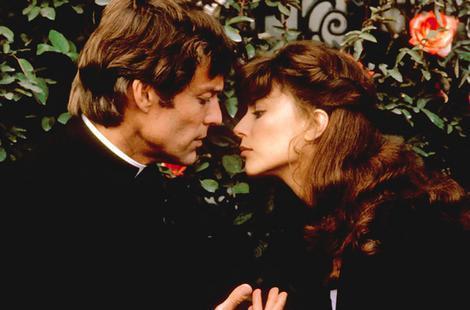
Anyone out there old enough to remember The Thorn Birds? A best-selling book in 1977 and a popular TV series starring Richard Chamberlain and Rachel Ward. The love story involving Meggie Cleary and the strikingly handsome and ambitious priest, Father Ralph de Bricassart tugged at heart string across the world.


It struck a special chord with me because a 17-year-old school friend had had an affair with an equally beautiful Catholic priest. All of 16 myself I walked her path of desolation through the minefield of nuns, parents and Church as she was labelled a temptress and he was relocated.

I’ll never forget the day he arrived to conduct a three-day silent retreat for us girls – about 150 teenagers with raging hormones and not a boy in sight. As he walked on the stage, black cassock, white dog collar, thick black hair, the collective ooh, aahs and giggles must have sent shock waves through the gaggle of nuns who had joined us for his first address.

It was group adoration at first sight.

For my friend – tall for her age, a bit overweight, introvert and battling a bad case of acne, it was the beginning of much, much more. Long story short, she arranged a private session to pour out her troubles. It was close to end of term and they continued to meet during the school holidays. Her mom, a single parent with problems of her own, thought it was for spiritual counselling.

I can’t remember how the truth eventually emerged but I will never forget the depth of my friend’s misery. How she was judged and why she attempted suicide. Nearly 20 years later we bumped into each other in a shopping mall and she shared that she still loved him. She even joked that he’d helped to clear her acne.

As a mature woman all I could think about was how he had abused a desperate young girl. Years later when I was ordained into Anglican priesthood I came to understand that it’s not all about paedophilia or abuse. Priests fall in love; ordination doesn’t stifle libido, therein lie some of history’s most famous love stories.


MODERN LOVE STORY


The recently published letters written by the sainted and popular Pope John Paul II to the Polish-born US philosopher Anna-Teresa Tymieniecka have added to the cache. Although her letters are still locked away, the 350 he wrote reveal real affection and I found his gift of a mini scapular to her deeply moving. A gift from his father, he’d worn it since childhood and it would have been one of very few possessions.

She was married and he had taken a vow of celibacy but that scapular, an intimate item, reflected a deep spiritual bond.

In case you are wondering, a mini-scapular consists of two postage pieces of cloth, wood or laminated paper. About the size of a postage stamp it features a prayer text or a devotional picture linked by cords and is worn with one image hanging on the chest, the other on the back. 


DOING WHAT ONE OUGHT
One of Pope John Paul’s better known quotes is: Freedom consists not in doing what we like, but in having the right to do what we ought. Against the backdrop of his deep friendship with Tymieniecka it assumes huge significance.


Edward Stourton, the lead journalist behind the BBC report, was told that Tymieniecka had professed her love in a letter written from a park bench in Krakow in summer 1975.

John Paul visited her and her family the next year when he spoke at Harvard.

In a letter dated Sept. 10, 1976, he wrote: “Last year I was trying to find an answer to the words, ‘I belong to you.’ Finally, before leaving Poland, I found a way — a scapular.”

In subsequent letters, he referred repeatedly to it, saying it allowed him to “accept and feel you everywhere, in all kinds of situations, whether you are close, or far away.”


THE END
Friends of Tymieniecka told Stourton she was at the Pope’s bedside on the eve of his death at age 84 on April 2, 2005. Her husband, Hendrik S. Houthakker, a Harvard economist who served in the Nixon administration, died in 2008. She died in 2014, at 91.


It’s a great story, possibly because it leaves so much to the imagination and it has the best of ingredients – a beautiful brainy woman and the most powerful man in the Catholic Church.


Monday, 1 February 2016

NO VOCATION UNDER THE DUVET


Writing this blog has been a wake-up call.

I have always fallen short in the retentive memory department and I really battle to recognise people until I have had a lot of interaction with them.

The former translates into cramming for school exams, struggling to remember names in my congregations, forgetting birthdays and the dates of life’s milestones. The latter is a mild form of ‘face blindness’ which is why it didn’t help when the Lesotho police once put me in the same room as a man who had held a gun to my head the night before.


I’d helped them capture him and his accomplices but he’d changed his distinctive tee shirt and red shoes which I would have recognised like a shot. He was also too far from me in the large room to pick out his distinctive body odour which I still recall 40 years later.

Of course the cops had to let him go.

Reams have been written about face-blindness, which in its extreme form is called prosopagnosia and is a neurological disorder. Who knows, my mother may have dropped me on my head as a baby but I’m pretty certain that both deficiencies are the outcome of being an adored only child primarily focussed on future achievement and self.

It hurts


Problem is, I hurt people, as in when I confused two women in my parish. The one had visited me in my home with her husband but I mistook another for her the following Sunday.


It’s why when I shop in our local mall I smile and greet all shop assistants – many of my parish work there. I also do a lot of nodding and eye contact as I wander for shop to shop. If anyone half smiles at me I do a proper greeting. (Father Christmas and I should open a charm school together.)

A fuzzy past


As I blogged my journey towards Anglicanism and my rather unusual priesthood, I was forced to work out dates and remember details that were part of the blur of my past. Looking back, I am amazed that my lifelong friends have stuck with me. (Spare a thought too for the rectors I have worked under and my bishops.)

The now

The blog was also a whole lot more. It forced me to take measure of the present. One in which I, a ‘retired priest’, pick and choose my involvement with Church. I commiserate with friends who still have to attend Council meetings and synods as well as deal with pew politics. I pontificate on Facebook. Twitter, Google+ and in the blogosphere.


By the 20th post it was becoming increasingly more difficult to write. Besides being thoroughly bored with myself, the blog was a convenient distraction from the relevance of my present relationship with God and my chosen Church.

I’d forgotten the key lesson I’d learned so many years ago from the Mother’s Union at St James in Diepkloof, Soweto: There is no retirement from God or ministry. Vocational seasons may end but you can’t spend the Winter of your life in bed with a duvet over your head.


The blog posts proved a soul-jolting alert that I had allowed myself to drop into a quagmire of complacency. I’d forgotten the long hard journey I’d undergone to reach an understanding that my prime vocation lies in my talent for communication, not parish ministry.

I’d forgotten, and hadn’t even blogged about, the long battle to accept that editing the Southern Anglican magazine, serving as the archbishop’s international media person and using my writing skills was my vocation.

In recent years I’ve effectively relegated my vocation to ‘the good old days’.

As I reached blog post 32 it was like pushing a wheelbarrow full of rocks. December offered the excuse to take a break. Blog 33 wasn’t any easier, particularly within my personal anger of yet another Anglican delay regarding homosexuality. When I re-read that rant I knew it was less about my relationship with Anglicanism and a whole lot to do with spending the winter of my vocation under a duvet.

For what it’s worth, herewith the result of my reflections. If anything they prove, yet again, that there are no coincidences. They are God-incidences. And, yes, God does have a sense of humour.

The first step was to acknowledge that my vocation is not to swan in and out of my parish on high days and when the rector is on leave. I may have to use Google a whole lot more these days but I can still write.

So, if writing and editing is my ministry where do I stand?

Ever stood on a rake and had the handle swat your nose? That’s what happened to me as I reviewed 2015, which I’d come to regard as annus horribilis. I’d lost my main source of income as the publisher I worked for had his own problems. There was a mad scramble to survive financially.

True to form, I tackled the problem myself with only the occasional desperate arrow prayer. (I’m superstitious about praying for money.) Eventually things got so bad, I conceded that I could do with some Godly assistance. (A smidgeon off a grovel.)

Call it luck or a God-incidence, shortly afterwards I was commissioned by the Church of Sweden to edit a remarkable book. Called 'Behold I make all things new'. Its contributors present a compelling case for reinterpreting the Jewish, Christian and Muslim sacred texts with regard to homosexuality.

I’d lived through the reinterpretation of the Bible to prove that apartheid was not God’s will. I’d watched Anglican theologians reinterpret Scripture to allow women to be ordained into priesthood. I had seen the pain Christians inflict on God-loving homosexuals. In short, I jumped at the chance to edit that book.

Besides providing a welcome editing fee, it has proved a personal blessing and I can’t wait for it to be published. (I will keep you posted).

In January this year I finished my mystery novel. Far from holy, it is also in the publishing pipeline and is set in the Anglican Church. Its main character is Archbishop Sibonelo Shakespeare Khumalo (his mother was an English teacher) and some of you may have met him on his Facebook account.

Shakes has a lesbian daughter who expects him to live up to his promise to preside over her marriage service and a wife that reads the bible far more literally than he does. But his immediate challenge is that he needs to solve a couple of murders to stop a campaign to defrock him.

It’s meant to be a fun read. The God-incidence is that the writing of it has forced me to walk in the shoes of an Anglican archbishop who is torn between his personal life, current theology and the need to avoid schism.

Needless to say, I was so busy with both books that the ‘vocation thing’ lost priority. Besides, there are two other books in the pipeline, I manage three Facebooks accounts, two Twitter accounts, this blog, a LinkedIn account and I potter in Google+.

I’ve hit the pause button. Please pray for me as I try to discern if God has deftly recalled me into a vocation of communication or if I am just interpreting that ‘call in the night’ to suit myself.

Meanwhile, I am encouraged by Rabbi Meir Baal Hanes who says: ‘Any interpretation of scripture which leads to hatred or disdain of other people is illegitimate.’

In the same vein, Karen Armstrong, the moving spirit behind the worldwide launching of a Charter of Compassion in November 2009, has stated: ‘If your understanding of the divine made you kinder, more empathetic, and impelled you to express sympathy in concrete acts of loving-kindness, this was good theology. But if your notion of God made you unkind, belligerent, cruel, self-righteous, or if it led you to kill in God's name, it was bad theology.’