
Why do Christians flip at any suggestion that Jesus and Mary Magdalene may have been an item? Why did the nuns who taught me throughout my school years cultivate the myth that Jesus was an only child? Was it because, heaven forbid that Mary should have had sex with the long suffering Joseph? (I was 50 years old when I realised Jesus had siblings.)
 |
| Not a sibling in sight |
What was the biggest unspoken question when Pope John Paul II’s letters, spanning 32 years, to a married woman were published? In my book, if he did have an oops with the beautiful Polish philosopher he deserved to be Ssainted for sticking with his vocation and serving a broken world.
SECOND COUSIN TO SIN
Fact is we Christians are incredibly hung up on sex, too often declaring it second cousin to another three-letter word – sin. Notably the heroines in our religious traditions are either virgins or reformed prostitutes. There is no middle ground. Too often we fail to take the measure of sexuality within the context of God’s plan for humankind.
Professor Dr Riffat Hassan, a Pakistani-American theologian, notes that human sexuality has been much debated in most religious traditions, including those of Judaism, Christianity and Islam.

However, while the Jews and the Muslims regard being sexual as good and certainly not the opposite of spirituality, in our early tradition we even regarded sex within marriage, as a necessary evil!
I paraphrase from Prof Hassan’s contribution to Behold, I make all things new, a book I recently co-edited.
The Qur’an encourages all Muslims who are able and willing, to marry a ‘virtuous’ or ‘chaste’ man or woman. Marriage is viewed as a sign of God’s mercy and a most solemn and serious pledge.
Traditional Judaism views marriage as a contractual bond commanded by God. A man and a woman come together and create a relationship in which God is directly involved (Deuteronomy 24:1).
GRUMPY OLD MEN
But in our early tradition celibacy was viewed as the prime Christian vocation. Paul didn’t think there was any point in saddling oneself with a spouse because he believed Jesus’ return was imminent. Although we must give grumpy Paul his due, he did say it was a personal opinion.

St Augustine didn’t make things easier. He taught that, while sex in the Garden of Eden had been good and rational, the grand Fall turned it into a mindless, bestial enjoyment. A sin that held us back from the contemplation of God.
As Karen Armstrong, eminent historian of religion, points out, his doctrine of original sin would fuse sexuality and sin indissolubly in the imagination of the Christian west. For centuries this tainted the institution of matrimony. Augustine’s teacher, St Ambrose of Milan, believed that ‘virginity is the one thing that keeps us from the beasts’. The North African theologian Tertullian equated marriage with fornication.
St Jerome wrote, ‘It is not disparaging wedlock to prefer virginity. ‘No one can compare two things if one is good and the other evil.’ (I kid you not)
IT GETS WORSE

Martin Luther, who left his monastery to marry, inherited Augustine’s bleak view of sex. ‘No matter what praise is given to marriage,’ he wrote, ‘I will not concede that it is no sin.’ (Nonetheless he and Katharina, a former nun, did produce six children.) He regarded matrimony as a ‘hospital for sick people’ which merely covered the shameful act with a veneer of respectability, so that ‘God winks at it.’
It wasn’t until the 16th Century that Frenchman, John Calvin, became the first western theologian to praise marriage unreservedly. Thereafter Christians began to speak of ‘holy matrimony.’
In short, the present enthusiasm for ‘family values’ is relatively recent. Mind you Catholic priests and gay Anglican priests are still required to be celibate. And the Catholic ban on artificial contraception implies that sex is only for making kids.
SEX CAN BE SPIRITUAL
Yet it was the Catholic Cardinal Basil Hume who wrote, ‘every experience of love gives us yet another glimpse of the meaning of love in God himself. Human love is the instrument we can use to explore the mystery of love which God is.’
Of course there is loveless sex but, let’s face it, sex between two people who do love each other can be glorious. A hymn to our Creator.
Needless to say, passion is fueled by obstacles – the basis of the world’s most famous love stories.

Throw a priest in the mix and you have a doozy.
MEGGIE AND FATHER RALPH


Anyone out there old enough to remember The Thorn Birds? A best-selling book in 1977 and a popular TV series starring Richard Chamberlain and Rachel Ward. The love story involving Meggie Cleary and the strikingly handsome and ambitious priest, Father Ralph de Bricassart tugged at heart string across the world.
It struck a special chord with me because a 17-year-old school friend had had an affair with an equally beautiful Catholic priest. All of 16 myself I walked her path of desolation through the minefield of nuns, parents and Church as she was labelled a temptress and he was relocated.
I’ll never forget the day he arrived to conduct a three-day silent retreat for us girls – about 150 teenagers with raging hormones and not a boy in sight. As he walked on the stage, black cassock, white dog collar, thick black hair, the collective ooh, aahs and giggles must have sent shock waves through the gaggle of nuns who had joined us for his first address.
It was group adoration at first sight.
For my friend – tall for her age, a bit overweight, introvert and battling a bad case of acne, it was the beginning of much, much more. Long story short, she arranged a private session to pour out her troubles. It was close to end of term and they continued to meet during the school holidays. Her mom, a single parent with problems of her own, thought it was for spiritual counselling.
I can’t remember how the truth eventually emerged but I will never forget the depth of my friend’s misery. How she was judged and why she attempted suicide. Nearly 20 years later we bumped into each other in a shopping mall and she shared that she still loved him. She even joked that he’d helped to clear her acne.
As a mature woman all I could think about was how he had abused a desperate young girl. Years later when I was ordained into Anglican priesthood I came to understand that it’s not all about paedophilia or abuse. Priests fall in love; ordination doesn’t stifle libido, therein lie some of history’s most famous love stories.
MODERN LOVE STORY

The recently published letters written by the sainted and popular Pope John Paul II to the Polish-born US philosopher Anna-Teresa Tymieniecka have added to the cache. Although her letters are still locked away, the 350 he wrote reveal real affection and I found his gift of a mini scapular to her deeply moving. A gift from his father, he’d worn it since childhood and it would have been one of very few possessions.
She was married and he had taken a vow of celibacy but that scapular, an intimate item, reflected a deep spiritual bond.
In case you are wondering, a mini-scapular consists of two postage pieces of cloth, wood or laminated paper. About the size of a postage stamp it features a prayer text or a devotional picture linked by cords and is worn with one image hanging on the chest, the other on the back.

DOING WHAT ONE OUGHT
One of Pope John Paul’s better known quotes is: Freedom consists not in doing what we like, but in having the right to do what we ought. Against the backdrop of his deep friendship with Tymieniecka it assumes huge significance.

Edward Stourton, the lead journalist behind the BBC report, was told that Tymieniecka had professed her love in a letter written from a park bench in Krakow in summer 1975.
John Paul visited her and her family the next year when he spoke at Harvard.
In a letter dated Sept. 10, 1976, he wrote: “Last year I was trying to find an answer to the words, ‘I belong to you.’ Finally, before leaving Poland, I found a way — a scapular.”
In subsequent letters, he referred repeatedly to it, saying it allowed him to “accept and feel you everywhere, in all kinds of situations, whether you are close, or far away.”
THE END
Friends of Tymieniecka told Stourton she was at the Pope’s bedside on the eve of his death at age 84 on April 2, 2005. Her husband, Hendrik S. Houthakker, a Harvard economist who served in the Nixon administration, died in 2008. She died in 2014, at 91.

It’s a great story, possibly because it leaves so much to the imagination and it has the best of ingredients – a beautiful brainy woman and the most powerful man in the Catholic Church.
As Karen Armstrong, eminent historian of religion, points out, his doctrine of original sin would fuse sexuality and sin indissolubly in the imagination of the Christian west. For centuries this tainted the institution of matrimony. Augustine’s teacher, St Ambrose of Milan, believed that ‘virginity is the one thing that keeps us from the beasts’. The North African theologian Tertullian equated marriage with fornication.
St Jerome wrote, ‘It is not disparaging wedlock to prefer virginity. ‘No one can compare two things if one is good and the other evil.’ (I kid you not)
IT GETS WORSE

Martin Luther, who left his monastery to marry, inherited Augustine’s bleak view of sex. ‘No matter what praise is given to marriage,’ he wrote, ‘I will not concede that it is no sin.’ (Nonetheless he and Katharina, a former nun, did produce six children.) He regarded matrimony as a ‘hospital for sick people’ which merely covered the shameful act with a veneer of respectability, so that ‘God winks at it.’
It wasn’t until the 16th Century that Frenchman, John Calvin, became the first western theologian to praise marriage unreservedly. Thereafter Christians began to speak of ‘holy matrimony.’
In short, the present enthusiasm for ‘family values’ is relatively recent. Mind you Catholic priests and gay Anglican priests are still required to be celibate. And the Catholic ban on artificial contraception implies that sex is only for making kids.
SEX CAN BE SPIRITUAL
Yet it was the Catholic Cardinal Basil Hume who wrote, ‘every experience of love gives us yet another glimpse of the meaning of love in God himself. Human love is the instrument we can use to explore the mystery of love which God is.’
Of course there is loveless sex but, let’s face it, sex between two people who do love each other can be glorious. A hymn to our Creator.
Needless to say, passion is fueled by obstacles – the basis of the world’s most famous love stories.

Throw a priest in the mix and you have a doozy.
MEGGIE AND FATHER RALPH
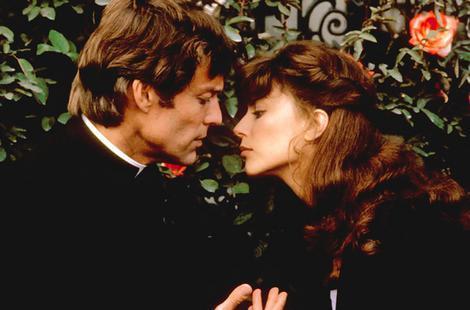

Anyone out there old enough to remember The Thorn Birds? A best-selling book in 1977 and a popular TV series starring Richard Chamberlain and Rachel Ward. The love story involving Meggie Cleary and the strikingly handsome and ambitious priest, Father Ralph de Bricassart tugged at heart string across the world.
It struck a special chord with me because a 17-year-old school friend had had an affair with an equally beautiful Catholic priest. All of 16 myself I walked her path of desolation through the minefield of nuns, parents and Church as she was labelled a temptress and he was relocated.
I’ll never forget the day he arrived to conduct a three-day silent retreat for us girls – about 150 teenagers with raging hormones and not a boy in sight. As he walked on the stage, black cassock, white dog collar, thick black hair, the collective ooh, aahs and giggles must have sent shock waves through the gaggle of nuns who had joined us for his first address.
It was group adoration at first sight.
For my friend – tall for her age, a bit overweight, introvert and battling a bad case of acne, it was the beginning of much, much more. Long story short, she arranged a private session to pour out her troubles. It was close to end of term and they continued to meet during the school holidays. Her mom, a single parent with problems of her own, thought it was for spiritual counselling.
I can’t remember how the truth eventually emerged but I will never forget the depth of my friend’s misery. How she was judged and why she attempted suicide. Nearly 20 years later we bumped into each other in a shopping mall and she shared that she still loved him. She even joked that he’d helped to clear her acne.
As a mature woman all I could think about was how he had abused a desperate young girl. Years later when I was ordained into Anglican priesthood I came to understand that it’s not all about paedophilia or abuse. Priests fall in love; ordination doesn’t stifle libido, therein lie some of history’s most famous love stories.
MODERN LOVE STORY

She was married and he had taken a vow of celibacy but that scapular, an intimate item, reflected a deep spiritual bond.
In case you are wondering, a mini-scapular consists of two postage pieces of cloth, wood or laminated paper. About the size of a postage stamp it features a prayer text or a devotional picture linked by cords and is worn with one image hanging on the chest, the other on the back.

DOING WHAT ONE OUGHT
One of Pope John Paul’s better known quotes is: Freedom consists not in doing what we like, but in having the right to do what we ought. Against the backdrop of his deep friendship with Tymieniecka it assumes huge significance.

Edward Stourton, the lead journalist behind the BBC report, was told that Tymieniecka had professed her love in a letter written from a park bench in Krakow in summer 1975.
John Paul visited her and her family the next year when he spoke at Harvard.
In a letter dated Sept. 10, 1976, he wrote: “Last year I was trying to find an answer to the words, ‘I belong to you.’ Finally, before leaving Poland, I found a way — a scapular.”
In subsequent letters, he referred repeatedly to it, saying it allowed him to “accept and feel you everywhere, in all kinds of situations, whether you are close, or far away.”
THE END
Friends of Tymieniecka told Stourton she was at the Pope’s bedside on the eve of his death at age 84 on April 2, 2005. Her husband, Hendrik S. Houthakker, a Harvard economist who served in the Nixon administration, died in 2008. She died in 2014, at 91.

It’s a great story, possibly because it leaves so much to the imagination and it has the best of ingredients – a beautiful brainy woman and the most powerful man in the Catholic Church.


