Showing posts with label Catholic. Show all posts

Friday, 9 October 2015

ANGLICAN DITHERING ON GAY ISSUE IS CRUEL


I need to take a step back to the discernment process that led, somewhat surprisingly, to me being deaconed and then priested. Actually 'surprisingly' is too mild a term. By the time I came out of that wash I expected a resounding "No".

In our diocese you went through a fairly long 'fellowship of vocation' process. We met regularly for training and were allocated mentors. If your mentor felt you were a suitable candidate the next step was a day spent with a psychologist.

The inkblot test
Mine was a Catholic nun who began with a Rorschach inkblot test. Not sure if it is still used but this is a process whereby the subjects' perceptions of inkblots are recorded. They are then analyzed using psychological interpretation, complex algorithms or both.

To quote Wikipedia, some psychologists use this test to examine a person's personality characteristics and emotional functioning. It has been employed to detect underlying thought disorder, especially in cases where patients are reluctant to describe their thinking processes openly. 


The image card is held up and you have to quickly say what it represents to you. The presumption being that you have never seen it before.


The nun was such a nice woman I didn't have the heart to tell her I'd played the Rorschach game several times at parties, where the interpretations were far from holy. BESIDES I really, really wanted her to tell my bishop I'd make a great priest.


A Rorschach inkblot card


The system is named after the psychiatrist who introduced it back in the 30s. I also didn't have the heart to point out that he subsequently had serious doubts about its usefulness.

So I gave her nice holy interpretations like "monks dancing in a circle holding hands". To give the good sister her due, she did tell the bishop I had a tendency to view the world with rose tinted glasses. But then she also told him that I was so upset by my divorce that I'd started wetting the bed. Silly woman had read her handwritten notes incorrectly - it was my younger son who had been affected.

In all it was an interesting day. After one of many other tests she asked if I knew I had an eccentric genius IQ. Surely all only children born of doting parents know that?


Discernment committee

Ah well. At least her report got me to the next step - the discernment process. This is a full day in which you are interviewed by small teams on various aspects of your life. The teams meet at the end of the day to discern if you should be deaconed and also if you should go forward for priesthood.

I knew I'd blown in with my very first response.
Question: What will you do if you get turned down today?


The correct answer, with eyes humbly downcast, should have been: "I will accept it as God's will." But the joking retort just flew out of my mouth before I could stop it: "I'll probably have a nervous breakdown!"

In the 'good stewardship' session I admitted I was born to shop (despite being broke). In the health session I had to be honest:  instead of exercising, my preference was to lie down until the feeling passed.


Well at least the outcome proved that Church does have a sense of humour.

Shot to hell
Looking back I am aware that by the time I was deaconed my spirituality was shot to hell. Too much time and effort had gone into juggling my life and impressing folk who had no concept of my busy work load. It is a constant refrain from so many self-supported clergy.


Part of the problem was that my bishop at that time had advised me to change Spiritual Directors. The suggestion was well meant and he was among the best directors, but I'd travelled too far and too deeply with my first. I still turn to her. 

It was an important lesson. Find one that works for you and your personality type.

A short-lived deacon
I'd heard tales of desperate-to-be-priests being held in deacon limbo for years. So it was a huge relief to only wait 5 months. Frankly, except for that crossed deacon's stole and the long white dress, life as a deacon was no different from being a hard working lay minister.

The Jazz in my heart
Naturally, as a died-in-the-wool kugel, I had my chasubles and cope specially designed. One well meaning fellow ordinand did warn me that it wasn't a good idea to have a gold saxophone embroidered on the top left of the front of my green one. Advice I ignored. 
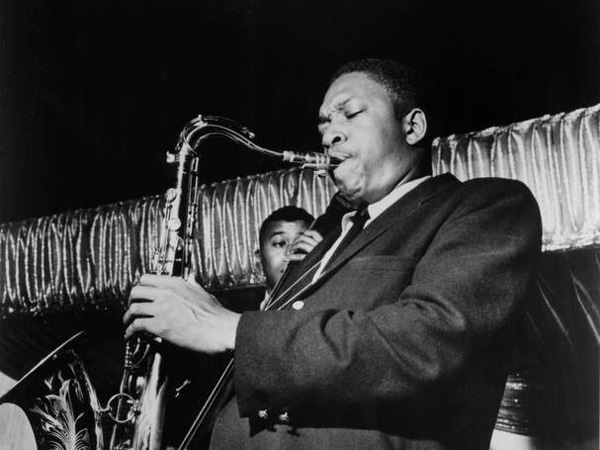


I am a John Coltrane fan and the Trinity is the jazz in my heart.

Invaluable advice that my bishop did give me was that as an extrovert I would be the exception, not the rule, among clergy. He shared that he often felt holier in a large assembly that in a silent retreat. I came to understand that no one spirituality fits all. It's okay to prefer progressive jazz to an organ recital.


Soon after I celebrated with a quarter cow and lots of chickens it was time to party again. The parish catered. I was grateful and my bank manager was happy. 

DRC makes history As I write this,  news has just filtered through that the Dutch Reformed Church in South Africa voted 102 to 88 in its synod in favour of ordaining gay ministers and blessing same sex unions. Real history in the making and placing the generally conservative protestant denomination well left of us Anglicans.  

I suspect the Methodists may just pip us to that post as well. 

In case you are wondering, the rest of our global Communion is not in step with our Episcopal cousins. Nor is it likely to be in the near future. Meanwhile the hurt and pain among our gay and lesbian clergy escalates. 

The dithering is cruel.


Monday, 5 October 2015

BISHOPS CAN BE DOLLS

The after party for my deaconing on December 1 2000, was a hoot. 

Hat's off to my family and the northern suburbs white friends who braved the journey from the Cathedral in the centre of the city to Soweto in the deep south. It was a  trip to no-man's land for most of them. Moreover, it was a Saturday evening. 

Their abiding image of Soweto was of death, carnage and violence. In fact it is a 'city', with a variety of neighbourhoods and various levels of safety. 

Diepkloof was a nice suburb. 


Some upmarket homes


and others not so posh.


Because I hired a bus to get them in and out everyone was pretty relaxed.

As I've mentioned before, my parish did me proud. The food was beautifully cooked and presented. The hall was decorated. The music and the singing was unforgettable. The St James folk had gone to inordinate lengths. (As I write this I am choked.)

A deacon's stole
Next day I wore my deacon's stole appropriately crossed in front and tucked into the girdle around my alb, which my domestic helper and I called 'that long white dress'.

(Cringe. I know. I know. I'd lost my money. We'd moved into a pretty crummy suburb and used the dog's bath for a while. But I was basically a kugel. My wonderful domestic helper travelled that long road with us. Today she manages a small business for me.) 

Back to being a deacon. 

At that time there was huge drive to push the concept of 'the ministry of all'. As lay ministers we'd visited the sick, conducted funerals (too many people were dying of AIDS related diseases). Many of us had also conducted Baptism and Confirmation classes. We'd even officiated at services with pre-consecrated wafers! Essentially we'd been doing 'deacony' stuff for quite a while before our ordination. 

I seriously wondered why one couldn't just be done and dusted straight into priesthood in one shot.  

Not by osmosis
By then I'd studied and passed 13 theological subjects but I have always been conscious of not having absorbed Anglicanism - the tradition, the vestments, the ritual - by osmosis.  

So I was delighted to discover the modern cassock alb which meant I could chuck the girdle. To this day I see nothing holy in a pall, especially for the extra chalices. It's only a useful cover to keep insects and dust out. My heart bleeds for lay folk who get themselves into a knot about these things when serving at the altar. There is such a danger of confusing ritual with worship.


Useful for keeping flies and dust out

My other world, which included working as speechwriter and media liaison officer for Archbishop  Njongo Ndungane, involved bishops, whose names I could never remember. 'Doll' did come in useful as most were very gracious.  (It's a strange fact - bishops are often less status conscious than their clergy.)

A horrific pandemic
There was also that 'AIDS' thread. Although Njongo's prime focus was development, by 2000 the HIV/AIDS pandemic was horrific. Africans were dropping dead at an alarming rate. Stigma reigned supreme. Our State President and our Health Minister were denialists. Refusing to acknowledge any connection between the HIV virus and AIDS she advocated garlic and sweet potatoes over anti-retrovirals.  They were dubbed 'a medicine from hell.'

Njongo declared the national AIDS policy "sinful" 
in 2000 led a protest march on parliament.

Meanwhile, his international advocacy role was growing apace and President Clinton invited him to a White House function on World Aids Day  on the first of December that year.


Always one to marshal expertise for his pet projects, the archbishop zoned in on Ted Karpf. The tall  Washington  priest with a Texan accent had written the liturgy for the AIDS Day service. But was better known for risking the loss of an entire congregation for insisting that a man with AIDS be allowed to attend the Eucharist and receive Communion using the chalice.   


The Rev Cannon Ted Karpf
                     
That first week the infected person was too ill to attend and nobody else pitched. In short, he experienced every priest's nightmare - an empty church.

Ted has a great turn of phrase so I'l let him share the next bit, "The night before the White House events, I learned an important life lesson: never drink scotch during a decision-making session with an Archbishop on an empty stomach. In the course of a long conversation, he suggested that I come to South Africa to help build an AIDS response.

"It was a major challenge as the province included 10 million people in seven countries, including the worst-affected in the world. Njongo argued that God had answered our prayers and it was clear what I was really called to do. I capitulated.

"The next morning at breakfast with the President, Sandy Thurman, and South African ambassador Sheila Sisulu, the President offered the Archbishop whatever support he wanted. The response was: “I want this priest, Ted Karpf, to come to South Africa to work with me.”

Ted was instructed to go to Africa where the archbishop steered him into strategic planning on how to meet the challenges of HIV/AIDS in 23 dioceses over half a dozen countries.

Above all, our new AIDS champion was to listen.

Never one to stay quiet for long, Ted soon had us all listening and responding. He and the archbishop quickly became a formidable force.
Together they developed a programme, coining the notions: We are building a generation without AIDS, as well as No one dies alone and no one cares alone.

Funded by the British government (DFID), the Americans (PEPFAR) and many others, it was until recently, the largest funded programme for faith-based AIDS work in Africa. 

An added bonus for me was a very special friendship. The spare room in our home is still referred to as 'Ted's'. (Don't get too excited, he's gay.)

Part of what brought us together was the fact that we had both discovered Anglicanism in adulthood. And he, like me, had a strong Catholic connection. 

Do you see Jesus?
Ted tells the delightful story of a great aunt, an immigrant Irish nun, a Sister of Charity. "She saw it as her mission to convert her heathen nephews and nieces. We would go to see her at her convent, and she would take us, gravely and with great care, to the sacristy in the convent. 'Do you want to see Jesus?' she would ask. 

"Then she would solemnly take the key out of the sash in her robes, go to the tabernacle box, and open it slowly. 'Do you really want to see Jesus?' 'Yes', we would answer. 


"She would reach in, and pull out the host, (a large consecrated wafer.) By now I was convinced that Jesus must be tiny, a kind of Tom Thumb. She would carefully pull out her hand, then, before we saw anything, thrust the door closed. 'You can’t see,' she said, 'because you are not Catholic'. And that was that."


There's plenty more to tell of Ted. I have an abiding memory of  him teaching me how to celebrate the Eucharist the night before I was priested. We used an ironing board, dishcloths and an excellent red wine.

Saturday, 26 September 2015

WHEN GROWN MEN CRY

There I was,  prostrate and with mother's pearls digging into my chest during my ordination to the diaconate. Regrettably I must leave myself face down for another week.  I digress to ponder on  a 78 year old man in a long dress and the power of gospel teachings to make grown men cry.

Pope Francis' historic trip to Cuba and America had millions of us glued to our TVs.  Speculation was rife. Would the Castro brothers take out heavenly insurance and convert from Communism to Catholicism?  Would there be an assassination attempt or a lone wolf  ISIS attack?  

Would the Pontiff rant at America's politicians? Would he ignore the advice given by the Secret Service? 

None of the above. But he did make history. And he did so by simply offering the gospel message of love.

In Cuba, where religion was banned for decades and Communist ideology has ruled with an iron fist, there were no water cannons or teargas when he said, “Service is never ideological, for we do not serve ideas, we serve people.” 


Instead he was invited to tea with Fidel Castro and his family. Of course Francis had been key to the rapprochement between Cuba and the USA.

Francis also urged Cuban believers to play their part in transforming the country. Reminding that being a Christian “entails promoting the dignity of our brothers and sisters, fighting for it, living it.”

History was made when he spoke gently to Congress, scene of so many bitter partisan battles in recent years. Besides receiving two standing ovations by the Republican-held seat of power, (home of ardent capitalists) he was interrupted by applause 24 times! Yet his message, in broken English, was pure gospel. As in 'love one another.' 'Give preference to the poor and vulnerable.'

While he was tough on Catholic priests and nuns, he gently urged America's politicians to be nicer to each other and work for the collective good.

For me a defining moment of the entire papal visit was seeing House Speaker John Boehner (a Republican) weep during the Pope's address to Congress. Also visibly moved was Vice-President Joe Biden (Democrat) seated beside him. Both of those powerful men are Catholics yet they have been caught up in some of the bitterest political battles of the decade. 


The following day Boehner announced his earlier than intended resignation. The turning point had been when Pope Francis humbly asked the Speaker in private to pray for him. 

As I write this political junkies like me are waiting anxiously to learn whether Biden will enter the presidential race. I have no doubt that his decision will have been influenced by the gospel message.

And I have no illusions. By next week politicians and Christians alike will all be having a go at each other. 
Maybe we could begin by being a little less fierce and a whole lot less judgemental.

But the optimist in me hopes that the widely publicised papal visit will remind all of us to vote good men and women into power.

There is one group that is going to be smiling for a long time. The marketing folk in Fiat must think they've died and gone to heaven. 


Among my favourite tweets are: "What would Jesus drive?"  and "Who knew a hatchback would hatch a pope."

Sunday, 23 August 2015

BAREFOOT AND PREGNANT IN THE CHURCH

It would be the start of a long, sometimes painful, but mostly joyful journey beyond Anglicanism into priesthood. 

Priesthood! 

For heavens sake I didn't know what half the tools of  my new trade were called - the robes, the stuff on the altar, and architectural divisions of a church. I found organ music jarring, I needed a hymn book for the words. The rituals of the Eucharist were foreign. Fact is I hadn't grown up with the externals that are taken pretty seriously. 


There was much to learn  but I wasn't alone. So often when I'd seek an answer from someone in the pews, The answer would be 'I don't know'. 


(I've still never been involved with a Christingle service and have just added it to my bucket list.)  

Fact is, unless you attend an Anglican School quite a lot is likely to fly over your head. Much depends on how your Confirmation Classes are handled. Little teaching on Anglicanism is done from the pulpit. Yet one of the most valuable sermons I experienced was on the Eucharist and its various forms. That sermon effectively transformed the service from traditional ritual to a sacrament steeped in Scripture.

Years later I would work in a parish run by a superb rector who had joined our ranks via the Assembly of God Church. Both of us had such fun taking Anglicanism to Anglicans.

Back to the story. Fr Andrew advised me to discuss my apparent calling with my Spiritual Director and my rector. Their response was basically 'We were wondering when it would happen.'  

My old circle of friends were alarmed. There were not so subtle hints about a delayed menopause. Others were still convinced the church was after my money. My mother was bemused and my sons had learned that I tended to do my own thing.

Then I woke up and smelled the coffee. There was a huge difference between dabbling in religion and answering a call to vocation.  

I booked an appointment with my psychologist who I hadn't seen in more than a year. After the session she half joked  that I probably hadn't ended up in the Catholic Church because it didn't allow women to become priests and I wasn't great at guilt. Many a true word....

That same year my son and I visited Jerusalem where we had the wonderful privilege of staying at the Ecce Homo Convent. It is in the Old  City and run by Catholic nuns. During breakfast a young nun approached me and asked if I was a priest. Of course the answer was no but I had a toe in the water. 


The entrance to the Ecce Homo  Convent on the Via Dolorosa


I, in turn, was curious why she had asked. Turned out she had sensed my calling and that she was going through terrible angst because she believed she had a priestly vocation. But for her that door was firmly shut. It was a sharp reminder of how many Anglican women had gone through the same pain before our Church had changed its mind on the matter.

Later I would come to appreciate what a bitter and hard won battle had opened the door to my own ministry. Also how fortunate I was that our southern African Province was so ahead of many others. At the time of my calling the Church of England was still only allowing women to go as far as the diaconate  - the first step to priesthood. 


In  November 2012,  about 18 years after the Anglican Church in southern Africa decided women could become bishops,  Elinha Wamukoya of Swaziland (right) made history  as the first woman to be elected.  Shortly afterwards Margaret Vertue was made Bishop of False Bay.  


Back to my session with my psychologist (turned out she was Jewish).  I left her confident that, at the very least, I should be going through the formal discernment process.

Soon I was enlisted into a Fellowship of Vocation programme. Ours was a group of varying ages from gungho youth to widows and they were much holier than I was. Nonetheless there was a powerful common denominator  - we were all pretty desperate to crack the nod for priesthood. 

As such we were all vulnerable to the hurts that come with being at the bottom of a woodpile. 

The young men were being strongly advised to 'first go forth and experience the world' and I know we lost a couple of potentially good priests. Once you are on that corporate ladder with a family to keep it's hard to change track.  

All the women in my group were middle aged and most had gender war stories to tell. We would all be self-supporting and would often joke about being cheap labour.

The church may have officially approved the ordination of women but some rectors still had one foot in the dark ages. I remember how one tall friend was instructed to always stand a step below her rector because she made him look short! We were all studying for a Theology degree and most of us had had careers but too many were only allocated responsibilities that were seen as  'womanly' - the Church's version of barefoot and pregnant in the kitchen.

Mind you, I once attended a retreat that included rector's wives and several were in tears about what they were expected to handle at parish level. Professional accountants and even one engineer were expected to do 'womanly'  things in the parish. Yet in many cases those wives were the main bread winner.  (Just as we women would joke about being cheap labour full-time male priests joked about being 'kept men'.)

I had never had to kick my way through a glass ceiling and I was fortunate to be in a parish that empowered women. But that didn't mean I wouldn't get my share of hurts a bit further down the line.

Meanwhile, strategising was what I did for my business clients  and it seemed a good plan to serve on the Parish Council. I was duly elected and should have been great but I still cringe at the 'holy' platitudes I spouted during that year as I sought to convince the leadership that I was priestly material. 

I was awful and not re-elected the following year.     

Friday, 31 July 2015

MILLIONS KILLED BY STIGMA


Coming from a non-religious family and ‘modern’ social circle I did find some aspects of the Anglican Church decidedly weird. Not least the incredibly bitter debate about LGBT (lesbian, gay, bi-sexual and trans gender) issues. But it was all rather arms-length and it worked for me that Archbishop Desmond Tutu was saying he would rather spend the afterlife in hell than go to a gay-hating heaven.


Looking back I am still amazed at the God-incidence that took me to that parish, several suburbs away from where I lived. A friend in my Wednesday morning Eucharist group where we bared our souls to each other ran HIV/AIDS workshops for an NGO and was the first activist I’d met (no he wasn’t infected, just deeply caring). When I asked advice on where I could do volunteer work he advised me to check with Jenny Marcus who led a volunteer group at the Charlotte Maxexe Hospital’s HIV clinic.


God's punishment
I’m not great at dates but it was about 1999. There were no anti-retrovirals in South Africa, the disease was largely viewed as God’s punishment for homosexuality and promiscuity. The stigma, nurtured in religious circles swirled and surged and would emerge as a major killer in Africa. As it still is today.

I was asked if I could help on Thursdays. It had for decades been the traditional day off for domestic helpers and infected men and women were using that precious little time off to visit the ward in secret. They would have been fired on the spot had their employers known about their status.

I allocated three hours each week, which was as much as I could manage while still keeping my clients content. Looking back it was also probably about as much as I could cope with emotionally. When I arrived and the ward sister realised that I was the chief executive of a major PR agency she felt I’d be most useful in an administrative capacity. But a God-incidence saved me in the nick of time. Jenny arrived.

She immediately steered me towards the folk in the packed waiting room. Although the clinic only officially opened at 8am, many had queued at the door from as early as 5am. My first and most important lesson, one that has stood me in great stead for many years, was to watch her hug those folk and kiss them on the lips. I watched faces light up. I saw holiness at work. I met good people living in a hell of secrecy and, in too many instances, shame. I got to know decent middle aged men. Grandmothers who had never been unfaithful. Young mothers anxious that their babies were infected.

The unbelievable joy, usually after two years, of finding that the HIV virus had not transmitted from a mother to her child.


The joy of knowing a child had not been infected at birth

There’s plenty more to tell about Jenny, heroic doctors and nurses and the hell of a pandemic in a country where the State President (Nelson Mandela’s successor) refused to believe that HIV is the precursor to AIDS. He was aided (pun intended) and abetted by a new Minister of Health who believed anti-retrovirals were poison. She was punting beetroot, sweet potatoes and garlic as alternatives.

Dropping like flies
South Africans were becoming infected and dying at a horrific rate.

Many Anglicans were opting to dip their Eucharist wafer in the chalice instead of sipping from the communal cup. Ignorance and fear ruled. Christians were fully into ‘love the sinner hate the sin’ mode. Church was the last place people who tested positive would turn to. To this day I have never had a person come to the altar rail to ask for public prayer because they have tested positive. Such is the power of religious bigotry surrounding what has become a manageable chronic disease.

Some of you may have noticed that I skipped a blog post last week. I’m tempted to say it was because I was frantically busy.

Superstition?
Fact is, I’d been asked to bless someone’s car and after years of doing this without question I found myself wondering where the sacred and superstition meet.


How holy is holy water?

I shared my concern on Facebook. To date there are 22 comments. They range from folk who tie the water to their baptism and view the blessing as giving thanks to God. Others say the practice is a hangover from Catholicism or that the people who use the car should be blessed instead.

There were jokes about the need for holy protection from our taxi drivers and, inevitably, the one about the rabbi who snips a bit off the end of the exhaust pipe.

I’d love your comments.

Friday, 10 July 2015

IS GOD A FACEBOOK HOAX?

If there is one thing we Christians excel at it’s shaping God to our own purposes. 

We did it in the Crusades as we pillaged Asian cities, massacred Jews and Muslims and appropriated foreign property. We did it when we colonised ‘heathen’ lands, carrying a bible in one hand and a gun in the other. We did it when we kept quiet as our Jewish friends were sent to concentration camps and we did it when racial discrimination was legalised in South Africa.  

We manufacture a God who sees it all from our point of view and, when everything goes pear-shaped, we remould him, assuming our right to redemption and forgiveness. But we seldom make amends. 

I suspect that the worst shaping of God is not in cataclysmic historical events but in the daily detail of our lives. In what the nuns used to call our “besetting sins.”  It is also in the way we use religion.

Looking back on my previous blogs I realise I seem to have hurtled down the Anglican path at a great and fairly uncomplicated pace. Alpha, a spiritual director, an Open Door Retreat, Eucharist on Wednesdays and Sundays, two modules towards a theology degree, new Christian friends. (There must be a Brownie badge for all this). 


They should have put me on a TV so I could declare “I’ve found Jesus.” 

Fact is, I hadn’t really.

As an A type personality I am very competitive and self-critical. I’m always setting goals, my life lacks balance and I have to watch my blood pressure. Besides, you may remember, I’d emerged as an ENTJ on the Enneagram scale – a not so likeable ‘Commander’.

What I was doing, to a large extent, was jumping though the hoops and revelling in the spiritual and intellectual exercises - striving for A’s in my assignments.  I was also finding comfort in the close to Catholic ritual – my childhood comfort blanket and the God I was shaping was a mirror image of me and my opinions.

There was also my other life: my clients as well as a social and family circle that just wasn’t into religion.

There must have been a whole choir of angels groaning on my behalf.

Yes, I’d incorporated a spiritual dimension into my life. Much as I would have had I taken yoga seriously but I kid you and myself if I lay claim to a personal relationship with God at that stage. I was far more tuned into the adage “God helps those who help themselves”, than to total submission.

I still thank God for my exceptional Spiritual Director.  Trained by Fr Gerard Hughes, author of God of Surprises, she, never criticised, always gently questioned and very wisely suggested a three day retreat at a local Anglican Convent.  


My retreat director was a wonderful monk, Father Andrew Norton. He belonged to the Community of the Resurrection monastery across the road. 

Besides being wise and practical, he was a diabetic who loved to gobble the fluffy jam scones the sisters served for tea.


Deeply committed to the training and the supervision of Spiritual Directors, he was also responsible for introducing the Open Door Retreat in South African Anglican circles.  He was just what I needed at that stage.  Instead of gentle encouraging pats on the back he got me to take a long hard look at myself and at the Church. Fr Andrew was a realist not a romantic.  It was he who warned how deeply Church can hurt. He was right.


One of the exercises he gave me is one I still value and slip into today. I was directed to slowly walk around the beautiful convent garden five times. Each time focusing on one of my five senses – sight, hearing, smell, touch, taste.  Thanking God for what they had meant to me since birth and using them to appreciate the garden. It is a great way to meditate on the Creator and Creation.

The gateway to the beautiful convent garden


My Damascus Road moment was my meditation on my sense of sight – what it had meant to me since birth. On the walk I inspected an old tree, its shape, its leaves rustling in the breeze. Becoming aware of birds among its top branches, the sunlight peeping through. The bark was rough. I moved closer, the tiniest insects came into focus. And then it happened. As I peeped behind a fairly loose piece of bark I spotted a cocoon and watched spell-bound as a butterfly slowly emerged.


Now decades later, I can still draw on that wondrous image when I’m stressed or distressed. It draws me into the mystery of God the power of faith. That moment when you choose red or black and place your bet on a roulette table. You don’t have all the answers but you are willing to take a chance. It was the day I met the ‘God of Surprises’.

I wish I could tell you that I’ve never had a moments doubt since that meditation in the convent garden. But it is a compass point for me when I feel lost, in those moments when I wonder if God isn’t on a par with those awful Facebook hoaxes.


Have you had a defining moment in your faith journey?


Friday, 29 May 2015

NO SEX, WE’RE ANGLICAN!


Let’s take a step back.

I gave the Alpha Course a lousy rating in my previous posts. Yet the Alpha website says 27 million people have participated in courses across 169 countries. Those charismatic folk must be getting something right for a lot of people.

Why didn’t it work for me? Was it my spiritual or intellectual arrogance? Probably a good dose of both. 

Early on in my spiritual journey I underwent a Myers Briggs personality type assessment and emerged as an ‘ENTJ’. Referred to as field marshals we are said to have a natural tendency to marshal and direct. This may be expressed with the charm and finesse of a world leader or with the insensitivity of a cult leader.

In retrospect, I got far more out of Alpha than I appreciated at the time. For starters there were always questions to take back to my spiritual director, an irreverent woman with a great sense of humour. 

 As counterpoint she introduced me to Henri Nouwen who took theology out of my head and planted it in my heart. He helped me understand that I’d embarked on a lifelong relational journey, not a God 101 Course.

I was fascinated by the Dutch priest, professor, psychologist, theologian and social activist. A prolific author, he had a hectic schedule and was a sought after public speaker. Then he felt called to join a community where people with developmental disabilities live with assistants. 

 For 10 years he served as resident priest at L’Arche Daybreak near Toronto in Canada. Most importantly he was Adam’s assistant, spending up to two hours a day dressing, feeding, bathing, and shaving the severely disabled young man. It was time spent in meditation that yielded wonderful spiritual insights. Nouwen said he learned more about the spiritual life from his friends in L’Arche, than he had ever learned in classes of theology and psychology.

Henri Nouwen and Gord, a L’Arche resident, became friends. They travelled together to speaking engagements and their core message was ‘just open your heart’.

Fr Nouwen and others like Thomas Merton and Gerald Hughes helped me to understand that I’d embarked on an intensely personal relational journey. I stopped looking to Church to do the work. At best it was a supportive structure. One that offered me the sacraments, teachings and what had become invaluable fellowship. On that basis it didn’t have to be perfect.

Just as well. I was becoming increasingly aware of its quirks. As Alpha drew to a close someone in my group mentioned that it was okay to for gays to become priests as long as they didn’t have sex. I laughed. 

Then I learned that this wasn’t just an ‘Alpha’ thing. I got the same response elsewhere. It was official Church policy!
My pre-churchfriends were just as bemused. We all wondered if the married priests and bishops, who were presumably enjoying their conjugal rights, had any concept of what was being asked of gay clergy. Did they really believe that healthy humans with no vocational call to celibacy would feel obliged to obey?

Years later a married Anglican friend shared that he’d given up sex for Lent and nearly ended up wrapping his Merc around a tree. It proves my point.

Besides, the same exponents of celibacy for gay priests would often righteously opine that the reason the Catholics were having problems with paedophilia was that they didn’t allow their priests to marry.

No, I’m not lesbian although I suspect some people in my village think I am - as an in-house joke, my son calls me ‘Dad’. It’s a play on ‘Father Loraine.’ But I have counselled too many good Christians who have gone to hell and back wrestling with their sexuality. The official Anglican stance on same-sex relationships was and still is an issue that bothers me greatly.

When the Irish recently made history by voting for same-sex marriage the Catholic Archbishop of Dublin declared that the Church needed ‘a reality check’. I agree but I suspect we differ on what that reality is.


Comments are welcome.

Friday, 22 May 2015

KING THUMBS NOSE AT POPE

As I hurtled along my journey into Anglicanism I was reminded  
of the elephant in the sanctuary. King Henry 8th.
The nuns had dutifully made us non-Catholic convent girls aware of the lust filled recalcitrant king. How he’d thumbed his nose at the Pope who wouldn’t annul his first marriage so he could marry Anne of Boleyn.
Anne Boleyn
The sisters told how Henry had taken control of the Church in England. Destroyed the monasteries. Published the bible in English. Beheaded two of his six wives.

We teenage girls, starved of romance, were enthralled.  We fantasized about being wooed by a king. We ghoulishly imagined having our heads chopped off.  We didn’t care about Church politics. Nor did we bother about the apostolic succession. This is the belief that the apostles passed on their authority to their successors and so on.


The succession issue mattered to me. So I conducted my own research but Google was still a twinkle in Larry Page’s eye. History books became yet another fascinating side-path in my personal journey.

Fact is, back in Henry’s day Church was predominantly about politics and power. First-born sons inherited the titles land and wealth. So younger siblings often became ambitious priests. (Think Machiavelli and you are getting warm.) The Church had become the high road to political influence and wealth accumulation. Vocation, celibacy and poverty were part of the small print many overlooked. 


Of course there were exceptions on both sides of the English Channel. They brought new meaning to ‘saint’.

Notably the king still gets a surprising mix of good and bad Press.  Several Catholic websites paint him as evil personified, egotistical, harsh, and insecure.  Political commentators are kinder. We Anglicans tend to ignore the elephant.

In a nutshell Henry (1491-1547) played the role of a Renaissance man to the hilt. His court was a centre of scholarly and artistic innovation. Glamorous excess kept him on the brink of financial ruin.
Holbein's The Ambassadors shows the luxurious display expected of Tudor diplomats.Holbein's .
Real and perceived enemies were tortured and executed. All good fodder for modern movies and soapies. 

Henry’s main dispute with the Catholic Church was with papal authority. Yet he was quick to institute the concept of the divine right of kings.

Importantly, despite his excommunication from the Catholic Church, he continued to believe in its core teachings. He also retained the clergy who didn’t tick him off politically. So the apostolic line of succession was not severed. The likes of Cardinal Wolsey and Archbishop Cranmer had all been ordained by Rome. That succession would be continued within England and across the world.
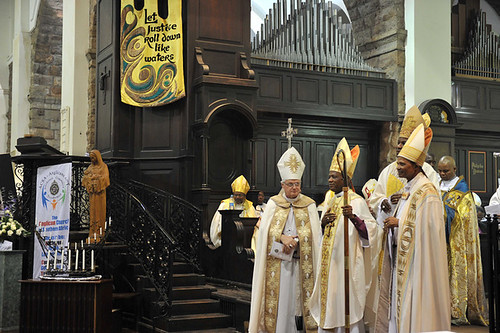
Bishop Steve Moreo was consecrated in St Mary's Cathedral, Johannesburg. 
A former political journalist, I wasn’t fazed by Henry’s shenanigans.  But I must admit to being relieved to learn that it is only in England that monarch is ‘the supreme governor and defender of the faith’. For me separation of State and Church are key.
As defender of the faith and supreme governor of the Church of England Queen Elizabeth even approves the Archbishop of Canterbury.

I was reassured.  But there was an important lesson. Do not confuse Church leadership with God.  

Meanwhile, having bunked the ‘Holy Spirit’ week-end, I’d underestimated the persistence of the Alpha Course facilitators. They arranged a special Saturday session for those of us who hadn’t been able to get away!

Convent raised I was good at guilt. By the Friday I was doing some serious grovelling to God. I was begging, no exaggeration, for the Holy Spirit to give me a good solid zap next day.  If not it would be like attending a Girl Guide camp and returning with no merit badge.

Needless to say, nothing did happen. The Holy Spirit had other plans. Instead I spent much of the Saturday afternoon consoling a distraught woman. She felt the Nicky Gumbel video for that day had instructed her to give up her live-in partner of 10 years. Yet she loved and respected him. She and her daughter were financially dependent on him. A good man, he’d been hurt by divorce and was disillusioned with marriage.

It was my first experience of the tensions between the ‘real world’ definition of family and Church teachings. Do we set too much store on a marriage certificate? It is, after all, an instrument of State? Does the sacrament of marriage not rest more in mutual commitment, caring for each other, respect. The vows?
What do you think?

By the way, I’m finding most of the comments on my blog posts are being made on Facebook. Thank-you. And I’m gobsmacked to find that these pages have been viewed from as far afield as Qatar, India and Sweden. Nine countries in all!

 Just a reminder, if you feed your email address into the blog site you will receive direct alerts.

Have blessed week.