Showing posts with label politics. Show all posts

Saturday, 26 September 2015

WHEN GROWN MEN CRY

There I was,  prostrate and with mother's pearls digging into my chest during my ordination to the diaconate. Regrettably I must leave myself face down for another week.  I digress to ponder on  a 78 year old man in a long dress and the power of gospel teachings to make grown men cry.

Pope Francis' historic trip to Cuba and America had millions of us glued to our TVs.  Speculation was rife. Would the Castro brothers take out heavenly insurance and convert from Communism to Catholicism?  Would there be an assassination attempt or a lone wolf  ISIS attack?  

Would the Pontiff rant at America's politicians? Would he ignore the advice given by the Secret Service? 

None of the above. But he did make history. And he did so by simply offering the gospel message of love.

In Cuba, where religion was banned for decades and Communist ideology has ruled with an iron fist, there were no water cannons or teargas when he said, “Service is never ideological, for we do not serve ideas, we serve people.” 


Instead he was invited to tea with Fidel Castro and his family. Of course Francis had been key to the rapprochement between Cuba and the USA.

Francis also urged Cuban believers to play their part in transforming the country. Reminding that being a Christian “entails promoting the dignity of our brothers and sisters, fighting for it, living it.”

History was made when he spoke gently to Congress, scene of so many bitter partisan battles in recent years. Besides receiving two standing ovations by the Republican-held seat of power, (home of ardent capitalists) he was interrupted by applause 24 times! Yet his message, in broken English, was pure gospel. As in 'love one another.' 'Give preference to the poor and vulnerable.'

While he was tough on Catholic priests and nuns, he gently urged America's politicians to be nicer to each other and work for the collective good.

For me a defining moment of the entire papal visit was seeing House Speaker John Boehner (a Republican) weep during the Pope's address to Congress. Also visibly moved was Vice-President Joe Biden (Democrat) seated beside him. Both of those powerful men are Catholics yet they have been caught up in some of the bitterest political battles of the decade. 


The following day Boehner announced his earlier than intended resignation. The turning point had been when Pope Francis humbly asked the Speaker in private to pray for him. 

As I write this political junkies like me are waiting anxiously to learn whether Biden will enter the presidential race. I have no doubt that his decision will have been influenced by the gospel message.

And I have no illusions. By next week politicians and Christians alike will all be having a go at each other. 
Maybe we could begin by being a little less fierce and a whole lot less judgemental.

But the optimist in me hopes that the widely publicised papal visit will remind all of us to vote good men and women into power.

There is one group that is going to be smiling for a long time. The marketing folk in Fiat must think they've died and gone to heaven. 


Among my favourite tweets are: "What would Jesus drive?"  and "Who knew a hatchback would hatch a pope."

Friday, 10 July 2015

IS GOD A FACEBOOK HOAX?

If there is one thing we Christians excel at it’s shaping God to our own purposes. 

We did it in the Crusades as we pillaged Asian cities, massacred Jews and Muslims and appropriated foreign property. We did it when we colonised ‘heathen’ lands, carrying a bible in one hand and a gun in the other. We did it when we kept quiet as our Jewish friends were sent to concentration camps and we did it when racial discrimination was legalised in South Africa.  

We manufacture a God who sees it all from our point of view and, when everything goes pear-shaped, we remould him, assuming our right to redemption and forgiveness. But we seldom make amends. 

I suspect that the worst shaping of God is not in cataclysmic historical events but in the daily detail of our lives. In what the nuns used to call our “besetting sins.”  It is also in the way we use religion.

Looking back on my previous blogs I realise I seem to have hurtled down the Anglican path at a great and fairly uncomplicated pace. Alpha, a spiritual director, an Open Door Retreat, Eucharist on Wednesdays and Sundays, two modules towards a theology degree, new Christian friends. (There must be a Brownie badge for all this). 


They should have put me on a TV so I could declare “I’ve found Jesus.” 

Fact is, I hadn’t really.

As an A type personality I am very competitive and self-critical. I’m always setting goals, my life lacks balance and I have to watch my blood pressure. Besides, you may remember, I’d emerged as an ENTJ on the Enneagram scale – a not so likeable ‘Commander’.

What I was doing, to a large extent, was jumping though the hoops and revelling in the spiritual and intellectual exercises - striving for A’s in my assignments.  I was also finding comfort in the close to Catholic ritual – my childhood comfort blanket and the God I was shaping was a mirror image of me and my opinions.

There was also my other life: my clients as well as a social and family circle that just wasn’t into religion.

There must have been a whole choir of angels groaning on my behalf.

Yes, I’d incorporated a spiritual dimension into my life. Much as I would have had I taken yoga seriously but I kid you and myself if I lay claim to a personal relationship with God at that stage. I was far more tuned into the adage “God helps those who help themselves”, than to total submission.

I still thank God for my exceptional Spiritual Director.  Trained by Fr Gerard Hughes, author of God of Surprises, she, never criticised, always gently questioned and very wisely suggested a three day retreat at a local Anglican Convent.  


My retreat director was a wonderful monk, Father Andrew Norton. He belonged to the Community of the Resurrection monastery across the road. 

Besides being wise and practical, he was a diabetic who loved to gobble the fluffy jam scones the sisters served for tea.


Deeply committed to the training and the supervision of Spiritual Directors, he was also responsible for introducing the Open Door Retreat in South African Anglican circles.  He was just what I needed at that stage.  Instead of gentle encouraging pats on the back he got me to take a long hard look at myself and at the Church. Fr Andrew was a realist not a romantic.  It was he who warned how deeply Church can hurt. He was right.


One of the exercises he gave me is one I still value and slip into today. I was directed to slowly walk around the beautiful convent garden five times. Each time focusing on one of my five senses – sight, hearing, smell, touch, taste.  Thanking God for what they had meant to me since birth and using them to appreciate the garden. It is a great way to meditate on the Creator and Creation.

The gateway to the beautiful convent garden


My Damascus Road moment was my meditation on my sense of sight – what it had meant to me since birth. On the walk I inspected an old tree, its shape, its leaves rustling in the breeze. Becoming aware of birds among its top branches, the sunlight peeping through. The bark was rough. I moved closer, the tiniest insects came into focus. And then it happened. As I peeped behind a fairly loose piece of bark I spotted a cocoon and watched spell-bound as a butterfly slowly emerged.


Now decades later, I can still draw on that wondrous image when I’m stressed or distressed. It draws me into the mystery of God the power of faith. That moment when you choose red or black and place your bet on a roulette table. You don’t have all the answers but you are willing to take a chance. It was the day I met the ‘God of Surprises’.

I wish I could tell you that I’ve never had a moments doubt since that meditation in the convent garden. But it is a compass point for me when I feel lost, in those moments when I wonder if God isn’t on a par with those awful Facebook hoaxes.


Have you had a defining moment in your faith journey?


Friday, 3 July 2015

IS GOD WHITE?

I was doing Morning Prayer and found in incredibly boring (still do most times). The best part was the daily Scripture readings. I often went way past the allocated verses, simply because I’d never read the Bible and wondered what came next.  Trust me, the juiciest parts are seldom in the lectionary.

The Open Door Retreat had drawn me into the dual discipline of praying and meditating. Moreover, we’d formed such strong bonds that we decided to meet for a 6.30am Eucharist on Wednesday mornings and to continue our sharing.

There was also those Old Testament and New Testament classes. They turned out to be official modules for a theology degree so my journey into Anglicanism had assumed a new dimension.

What a relief to learn that the Bible was not a direct dictation by God to various obliging scribes. There was no way I was ever going to take Jonah and the Whale literally. 

I would also quickly learn two more words to drop at cocktail parties – exegesis and eisegesis. The first is what brought the Scriptures and, eventually, Jesus sharply into focus for me. The second is what I believe makes it so easy for us Christians to be judgemental, self-righteous and downright cruel.

Exegesis literally means ‘to lead out of”. It requires careful and objective analysis of the Scriptures.  Who was the author? Why did he feel compelled to write? Who was his audience? What was the writer’s agenda? What was the social and cultural context in which it was written?

In short, exegesis requires careful, objective analysis that leads to a conclusion.

Eisegesis literally means ‘to lead into’. It involves subjective non analytical reading. It’s what enables us to make the Scriptures mean whatever suits us. Frightening stuff!  It has been used to justify, among other things, homophobia, gender discrimination, apartheid and slavery.

As we learned to exegete texts there was a natural progression to liberation theology and black theology. That’s when I knew I’d hit a home run. This stuff was really working for me. It was also when I realised that no matter how weird Anglicanism seemed at times it was also wonderful.


I’d also been taught Lectio Divina. A Latin term for ‘divine reading’ it is a way of reading the Scriptures whereby we gradually let go of our own agenda and open ourselves to what God wants to say to us. It is a wonderful way of listening with the heart and can be very calming when life is hectic. 

But let’s get back to exegesis and eisegesis. I am still gobsmacked at how a Church that claims ‘reason’ as one of its main pillars has allowed itself to be so divided by varying degrees of the two conflicting approaches to Scripture.  

Part of the problem in Southern Africa anyway is that we Anglicans dropped the ball on theological education. This is now being taken very seriously and technology is playing an increasing role. But we did have a very dry spell and too many of our preachers resort to eisegesis to make their point.

I digress. Back to my journey.  

I was living in three worlds. My ANC comrades used the term ‘liberal’ like a swearword. My upmarket suburban parish was primarily white and feeling unappreciated in our new political dispensation. My clients were over eager to capitalise on what they perceived as my political connections.

On the religious front I was increasingly bothered by how ‘European’ the Anglican Church in Southern Africa was. Yes we’d had Desmond Tutu as archbishop. His successor, Njongonkulu Ndungane, was also black but it was still a very long way to meaningful transformation.  Worship in the suburbs was worlds apart from the vibrant township services. Black Anglicans who relocated to the formerly ‘white’ suburbs, felt like foreigners.

But even in the townships I found a very white God and a Jesus who looked as if he’d been born in England. Clearly our early Christian missionaries - convinced that white was right and superior – had branded their product accordingly and imposed it on Africa. For them conversion involved Westernisation.

Years later, when I was ministering in Soweto I would ask kids in Confirmation class to give me a word picture of the holy threesome. This was invariably an old white man with a long beard seated next to a younger version of himself.  The Holy Spirit ranged between a bird and a white angel.  

(I’ve just carried out the same test on my Xhosa builder, my Malawian gardener and a black friend who manages properties and all in their late twenties, early thirties. It yielded almost the same result.)
 
 But.......
The BBC commissioned a picture of what the historical Jesus probably looked like

Back to exegesis. 

It was in those classes that I had my first inkling of how liberation theologians had used it to reinterpret the sacred texts in order to give preference to the poor, the marginalised and the oppressed. They had brought new meaning to sacred texts that had for too long been used to justify slavery, apartheid and gender discrimination.

It is an ongoing challenge.


Congratulations! Vivian Boyack, age 91, and Alice “Nonie” Dubes, age 90, who have been together for 72 years. They tied the knot shortly after same sex marriage was legalised throughout America. How sad they had to wait so long.!  http://bit.ly/1pI0wvE

Saturday, 13 June 2015

WERE THEIR KIDS DEAD OR ALIVE?

I’m going to cheat and jump ahead to my first June 16 in Soweto – the anniversary of a march by thousands of school children to protest against the introduction of Afrikaans as a teaching medium. That fateful day in 1976 when Hector Pietersen was the first to be fatally wounded as police lobbed tear gas, set dogs on the children and then fired at them.

The Madiba jive
In 2001, I was training for priesthood at St James Diepkloof and having a ball. My ‘black’ parish had made me so incredibly welcome that I would often forget my ‘whiteness’. I was learning to sing choruses (very badly) and developing my own version of the Madiba jive.

I loved Sundays in the township. After the morning service I could cross the road, pick up a couple of buns, head for the nearby butchery to collect a piece of steak and cook it on the fire outside. The tavern next door had taken to keeping a good red wine for me. I was getting to know the community. I was making friends I still have today.

Because I was ‘entering the church’ I’d had to give up my ANC membership card and resign from my branch committee but I still felt I had decent political cred. What an idiot! It took a wonderful man, Lekgau Mathabathe, to gently teach me two important lessons.

A retired headmaster of the famous Morris Isaacson High School, Ntate Mathabathe was a hero. He’d unequivocally rejected government’s instruction to teach in Afrikaans. He had also played a crucial role in providing direction and support to students, parents and the community before during and after the protest.

He’d risked his life and been detained. He also knew a great deal about jazz.

As a former political journalist I had written much about what we called ‘the 76 riots’ – the outcomes, the implications. Now I was in a parish close to where major events had unfolded. Many of my parishioners had been involved. My political genes were in overdrive.

Lessons
The first life lesson came when I complained to Ntate Mathabathe that our youngsters seemed not to take our ‘Struggle’ holidays seriously enough. His gentle response was that perhaps it was what true liberation was all about – a life in which our children weren’t burdened by the oppression their parents had lived under.

My second lesson came as I sat with him and some of our parish grandmothers discussing the awful June 16 events. Looking back I’m not sure our little gathering near the tea urn in the church hall was as coincidental as it seemed at the time. The old man knew I needed educating.

Mothers' heartache
Several of the women had been domestic helpers back in 1976 and they shared their stories. It was stuff I’d known but hardly thought about in my cocoon of white middle class privilege.


In those days ‘the girl’, as even grandmothers were referred to, lived in. Her accommodation in the back yard would have been just big enough to hold a single bed, a chair, a cupboard and a side table. If she was lucky there was hot water in the small adjoining toilet/shower.

Invariably she was allowed no visitors in the evenings, especially not by the man in her life. She started at about 6.30am and finished when the supper dishes were washed.

Her day off was Thursday, usually after she’d finished making the beds and washing the breakfast dishes. If she worked in the leafy northern suburbs of Joburg it would take an hour or more to reach her own home in the location. So there wasn’t much time to attend to it and her family in what was left of the day.

There were no cell phones and few were allowed to use their employer’s landline. TV, introduced in January 1976, was in its fledgling stage. News, always heavily censored, tended to travel via radio and over backyard fences.

On Wednesday June 16, 1976, the first clashes between police and children happened at about 8am. An hour later 10 000 pupils had converged on Orlando West High School. Many years later witnesses would speak of the township being 'on fire'.

South African history had been irrevocably set on a new trajectory.

As news of the march slowly filtered through to the leafy suburbs. Frantic mothers didn’t know if their kids were dead or alive. But there were houses to clean, meals to be cooked, washing to be done, dogs to be fed.

Geographically, socially and politically, life in their employer’s homes was a world apart from the townships. Even the slightest indication of interest in struggle politics meant, at best the loss of much needed employment. Moreover, whites were often as fearful of the regime as blacks were so a domestic helper with a child in the march could be reported to the security police. The few who were given compassionate time off couldn’t get into Soweto.

It was awful even for mothers who were in the townships. The unrest spread. When Mrs Masenya of Alexandra Township, east of Sandton, went to look for her children she was shot in the back by the police whilst crossing an empty stand.

As the St James women told me of the agony they’d gone through - the desperate furtive phone calls, the fearful speculation over fences not being allowed to rush home – they wept, so did I. It was as much for myself as for them.

Despite coming from a family that discussed politics and railed against apartheid at the breakfast table, I had never considered the diabolic effect that June 16 had had on domestic helpers caught up in my world. It was the beginnings of my understanding of why my black friends used ‘white liberal’ as a derogatory term.

A true benchmark
That day next to the tea urn I finally understood that the measure of oppression and political violence must not just be about bullets, body counts and political analytics. A mother’s heartache is among the truer benchmarks.

The women also told of how, despite the township being a cauldron of unrest and the powerful government response, Ntate Mathabathe had risked his life by going to the hospital and the morgue to identify dead and injured kids. It was he who gave them the news all South Africans were being deprived of by an inhumane system.

I will always be grateful for the sharing that day.

Okay, I’ll get off my soapbox, June 16, now called Youth Day, always affects me and I pray that I will never stop learning.  


Friday, 5 June 2015

SORRY HELL’S ANGELS BUT….


 Okay, so Alpha ended with me barely noticing. I was hurtling towards a destination I wasn’t sure I wanted to arrive at. After all, I was happy, successful and single. Why rock the boat?

But curiosity killed the cat. It can also change your life.

By the time Alpha ended I’d recovered from the shock of turning 50. The crematorium was fading into the distance. The urgency for taking out a heavenly insurance policy was fading.

At least at this stage I knew what I didn’t want. Topping the list was a chocolate-box Jesus looking like an Englishman in a nativity play. The model for soap powder ads. The ultra-white version who still holds sway in many township churches. (Tell some folk the historic Jesus had an olive skin as well as a prominent nose and they cringeJ.)

Fortunately my avid reading revealed a Jesus I was warming to.  I liked the man who knew the difference between quality and lousy wine. (Remember I was in PR, that first miracle was invaluable branding.) I was impressed by a guy who spoke truth to power, got seriously irritated, wept and attended dinner parties. I loved that he ignored class and cultural differences. 

Mind you, I wasn’t ready to go the ‘Jesus on a Harley’ route – it was only when I became chaplain to a bike club many years later that that image could work.


With Alpha behind me I finally hit the main road to Damascus.

At that time my spiritual director and her husband launched the first Open Door Retreat at the parish and invited me to participate. I’d got used to giving up one evening a week for Alpha so I reasoned ‘what the hell’ and signed on. 

Introduced to South Africa by Father Andrew, a CR monk, the retreats were designed for people too busy to actually take time out at a retreat house or with a religious community. They are based  on the spiritual exercises of St Ignatius  and  the format is very much about finding God in the hurly burly and realities of your own life. Praying as one can, not as one can’t.

For me it turned out to be much praying in the bath and not worrying about what Jesus could see.

Open Door groups range between 12 and seven and the retreat runs for nine consecutive weeks. You are given 15 minute daily spiritual exercise. For example, in the first week we were asked to take special notice of God’s loving creation. While the others took walks, gardened and made trips out of town, I invested in a pair of binoculars and checked out the large tree at the bottom of my garden – wine glass on hand. 

It worked for me. As did experiencing religion/spirituality within a real life context. It says something that of our group of seven 3 became  priests (including me!)

This brings me to something I come across quite a lot. The perception that God needs to be approached like an eastern potentate - crawling on our knees, beating our breasts. An extrovert bishop once shared with me how he felt far holier at a school assembly of 1000 boys than in solitude. I can identify. Felt it at a U2 concert in Cape Town.

Of course it’s imperative to make space and time for prayer and self-audits. As Dag Hammerskjold, former UN Secretary-General, pointed out, ‘an un-reflected life is a wasted life.’  But time is a precious commodity which makes the gym, the loo and your local coffee shop all okay. Whatever rocks your boat.

I’d love your comments. I notice most readers respond on my Facebook page and that’s also very welcome. Some, I suspect don’t respond because you are asked to ‘sign on’. That’s just to filter out weirdos, your information is not passed to marketers.


Friday, 22 May 2015

KING THUMBS NOSE AT POPE

As I hurtled along my journey into Anglicanism I was reminded  
of the elephant in the sanctuary. King Henry 8th.
The nuns had dutifully made us non-Catholic convent girls aware of the lust filled recalcitrant king. How he’d thumbed his nose at the Pope who wouldn’t annul his first marriage so he could marry Anne of Boleyn.
Anne Boleyn
The sisters told how Henry had taken control of the Church in England. Destroyed the monasteries. Published the bible in English. Beheaded two of his six wives.

We teenage girls, starved of romance, were enthralled.  We fantasized about being wooed by a king. We ghoulishly imagined having our heads chopped off.  We didn’t care about Church politics. Nor did we bother about the apostolic succession. This is the belief that the apostles passed on their authority to their successors and so on.


The succession issue mattered to me. So I conducted my own research but Google was still a twinkle in Larry Page’s eye. History books became yet another fascinating side-path in my personal journey.

Fact is, back in Henry’s day Church was predominantly about politics and power. First-born sons inherited the titles land and wealth. So younger siblings often became ambitious priests. (Think Machiavelli and you are getting warm.) The Church had become the high road to political influence and wealth accumulation. Vocation, celibacy and poverty were part of the small print many overlooked. 


Of course there were exceptions on both sides of the English Channel. They brought new meaning to ‘saint’.

Notably the king still gets a surprising mix of good and bad Press.  Several Catholic websites paint him as evil personified, egotistical, harsh, and insecure.  Political commentators are kinder. We Anglicans tend to ignore the elephant.

In a nutshell Henry (1491-1547) played the role of a Renaissance man to the hilt. His court was a centre of scholarly and artistic innovation. Glamorous excess kept him on the brink of financial ruin.
Holbein's The Ambassadors shows the luxurious display expected of Tudor diplomats.Holbein's .
Real and perceived enemies were tortured and executed. All good fodder for modern movies and soapies. 

Henry’s main dispute with the Catholic Church was with papal authority. Yet he was quick to institute the concept of the divine right of kings.

Importantly, despite his excommunication from the Catholic Church, he continued to believe in its core teachings. He also retained the clergy who didn’t tick him off politically. So the apostolic line of succession was not severed. The likes of Cardinal Wolsey and Archbishop Cranmer had all been ordained by Rome. That succession would be continued within England and across the world.
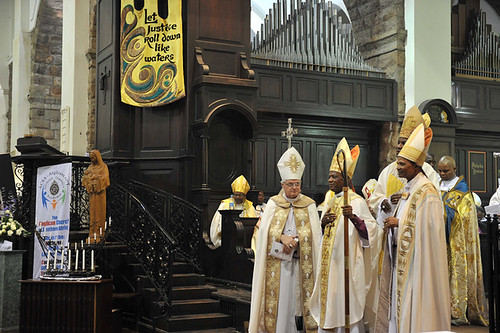
Bishop Steve Moreo was consecrated in St Mary's Cathedral, Johannesburg. 
A former political journalist, I wasn’t fazed by Henry’s shenanigans.  But I must admit to being relieved to learn that it is only in England that monarch is ‘the supreme governor and defender of the faith’. For me separation of State and Church are key.
As defender of the faith and supreme governor of the Church of England Queen Elizabeth even approves the Archbishop of Canterbury.

I was reassured.  But there was an important lesson. Do not confuse Church leadership with God.  

Meanwhile, having bunked the ‘Holy Spirit’ week-end, I’d underestimated the persistence of the Alpha Course facilitators. They arranged a special Saturday session for those of us who hadn’t been able to get away!

Convent raised I was good at guilt. By the Friday I was doing some serious grovelling to God. I was begging, no exaggeration, for the Holy Spirit to give me a good solid zap next day.  If not it would be like attending a Girl Guide camp and returning with no merit badge.

Needless to say, nothing did happen. The Holy Spirit had other plans. Instead I spent much of the Saturday afternoon consoling a distraught woman. She felt the Nicky Gumbel video for that day had instructed her to give up her live-in partner of 10 years. Yet she loved and respected him. She and her daughter were financially dependent on him. A good man, he’d been hurt by divorce and was disillusioned with marriage.

It was my first experience of the tensions between the ‘real world’ definition of family and Church teachings. Do we set too much store on a marriage certificate? It is, after all, an instrument of State? Does the sacrament of marriage not rest more in mutual commitment, caring for each other, respect. The vows?
What do you think?

By the way, I’m finding most of the comments on my blog posts are being made on Facebook. Thank-you. And I’m gobsmacked to find that these pages have been viewed from as far afield as Qatar, India and Sweden. Nine countries in all!

 Just a reminder, if you feed your email address into the blog site you will receive direct alerts.

Have blessed week.

Saturday, 16 May 2015

DIFFERENT STROKES FOR DIFFERENT FOLKS

There was a point when I acknowledged a need to worship God within a Christian context. It was the ‘how’ that challenged me.

Somewhere along the line I attended a ‘non-denominational’ service conducted by a dynamic pastor in a school hall.  I was used to the traditional Catholic and Anglican Churches of my youth so that hall just didn’t do it for me. (I later learned how traditional architecture, candles, vestments and icons are triggers for worship.) It also didn’t help that the sermon was on the need for women to obey their husbands.

The Anglican parish I was attending seemed to suit my basic needs. Designed by Sir Hebert Baker, the stone church had beautiful stain-glass windows. The services just bordered on the high and hazy. It felt like church.  

Importantly, the sermons were exceptional. (My rector became a bishop.)  And I’m still in awe of the God-incidence that took me past several other Anglican parishes between that one and my home.

Frankly the main reason I kept returning was the new social circle I was slipping into. I enjoyed the great conversations and the good red wine. My rector and his wife (my Spiritual Director) subscribed to the Benedictine principles of hospitality. They were generous hosts.  I, who’d become a real pleb as a single mother building up a major business, was drawn into company that enjoyed the arts and were creative. Most importantly, several of them understood the politics of our imminent democracy.

Never underestimate the power of planned fellowship!

I was also increasingly impressed by Jesus’ joie de vivre – the quality of wine he produced at the wedding, the dinner parties he attended, the friends he visited. His maverick approach to social taboos.

The Alpha Course wasn’t doing it for me.  Not enough reasoning for my personality type.  But I came from an era in which you finished your food (for the starving kids in Ethiopia) and anything else you started.

I did, however, draw the line at the residential week-end that most Alpha courses focus on. Over two days participants are encouraged to experience the Holy Spirit. For some this involves speaking in tongues. Others are zapped by the Holy Spirit and keel over.

No way Jose! When I was about 11 years old I’d fainted during Mass in Grahamstown’s Catholic Cathedral and wet my pants. There’d be no encore.  I bunked.

Nor did I have any desire to speak in tongues. Most of you will know that the gift of tongues is authenticated when, after a person has gabbled away, others are able to interpret. Invariably there’s a long and sometimes embarrassing pause before this follows. I often wonder if the interpreter isn’t just being kind.


Okay I accept it’s a special gift and that it can be a great way to lose oneself in God.  However, I’ve never seen it used publicly to really good effect. What’s your opinion or experience

Tuesday, 5 May 2015

RELIGION JUST A SUGAR PILL?


Looking back, the books I read in my run up to the Alpha Course were a wonderfully unfettered way to learn about Jesus and quite a lot of biblical stuff. Remember, I’d never attended Sunday School. My convent school religious education was based on a well-thumbed Catechism book that told me what to believe. My confirmation course in the Anglican Church was really an escape hatch to stroll through Boksburg, buy ice-cream and have toast for breakfast in the rectory.

Now 50, I was on an incredibly exciting journey of discovery – no epiphany, no lightning bolts but sensing a new beginning. It was also a welcome diversion from my hectic work and social diary, brain exercise. I hadn’t studied since my twenties. It was also long before The Tudors series was broadcast which would have put me off Anglicanism, despite that sexy Irish actor Jonathan Rhys Meyers.

Besides the off-the-wall books about Jesus, there were a variety of others.  These included fascinating archaeological finds (remember I wasn’t born with faith in my back pocket I needed proof), Judaic history and Greek history. Admittedly the Crusades and all their barbarity took a lot of shine off Christianity but then I wasn’t all that interested in following Jesus or killing people in his name. As the founder of a large PR agency I had long been used to dealing at chief executive level so the Son was interesting but if I was going to leap into a faith abyss I expected the ‘Main Man’ to do the catching. (In my PR life I was teaching chief executives ‘management by walkabout’ and the importance of an open door policy).

Running parallel to this was another development. In the second week after I’d attended my first Eucharist in about 35 years I called the parish to ask if they ‘did meditation’ in the Anglican Church. The rector’s response was “hang on I’ll call my wife, she’s into it”.  She was quick to share, “I’ve just finished a meditation and realised I think I’m God.”  We made an appointment for the next day.

I didn’t understand then but she was my first Spiritual Director.  The weekly psychology sessions were replaced by visits to the rectory. The coffee was excellent, the session were free and there was no reining either me or my reading in. Nor was there any proselytizing or effort to argue theological points. There was just lots of encouragement to continue my journey of discovery. And, because the rector had worked in the ad industry, a great understanding of my work life. There was also quiet amusement when I enquired if the best looking guy in the choir was single. (I’d find out later that he was gay.)

Today I count the three of them among my dearest friends and I fully agree with that marvellous Catholic priest Gerard Hughes who authored the best-selling God of Surprises. He argued that there is no such thing as coincidences, they are all God-incidences.

I’d spent a fortune on books but that little book would be that real beginning of my faith journey. Never one to subscribe to dogma Fr Gerry brought Church into different focus. Most importantly, he declared that God could never be fully understood because if this was so God simply wouldn’t be God. It made imminent sense and I stopped trying to prove God existed. Instead I stepped tentatively into the realm of mystery. But it was still a game of chance.

Those of you who were born with faith will probably have no concept how high those stakes were. So often when I share that I only really became a Christian at the age of 50 the response is “You must have been really happy for the first time in your life!” It wasn’t happiness I needed, I’d had huge doses of that throughout my privileged life. What I wanted was a spiritual dimension, balance. BUT with me still in full control.  

But I get ahead of myself! There was still the Alpha Course. It began with the traditional introductory dinner. I’d had a day from hell so had a long hot bath to unwind before heading for the parish hall.  I also poured an extra-large glass of wine to sip while I soaked, knowing full well that I’d be drinking fruit juice with supper. I was wrong.
As I walked through the door, I was offered a choice of “red or white wine?” An auspicious beginning. But as I watched the slick Nicky Gumble video, I couldn’t help spotting the production tricks. I could smell PR a mile off. But I enjoyed the company at my table and the following day my Spiritual Director assured me the course would “improve”. More of that later.

Writing this has reminded me how many of my Christians seems to enjoy unwavering faith. They never seem to doubt our religious rituals or question the Church’s teachings.  I now understand that it will never be as easy for me. Faith eludes me at the most inconvenient times. Sometimes I struggle to believe in unconditional grace. Or I just plain wonder if religion isn’t one big panacea. Yet I have acquired a relationship with God that permeates every aspect of my life – sometimes very inconvenient, invariably humbling but always dynamic.  I now accept that like most relationships this one will always have it ups and downs.  Of course I don’t play fair, I assume God will always be constant.

Do you also have faith wobbles? I’ve decided to give Archbishop Shakes, the main protagonist in my novel, a crisis of faith so your input would be very welcome.


May the Force be with you!

Thursday, 23 April 2015

AAAARGH! A MERE MORTAL

There are a couple of things that focus the mind on our mortality. Taxes, other people’s funerals, illness and turning 50 are some I can think of. 
For me, despite the likes of Joan Collins and Madonna, my 50th was a turning point. Despite taking comfort from the fact that I was biologically and mentally as much as 15 years younger than my grand-mother at the same age (so are you), there was a sense of crisis. 
This in itself was strange. An only child, I’d been raised to believe I had an eccentric genius IQ. I’d been a high achiever all my life. I loved myself (too much at times) and loved others easily because they didn’t make me feel threatened. I was making money and having fun. What on earth could the matter be?
You’ve guessed right: I’d sensed my mortality.
No I didn’t rush off to the nearest Church and find God. I did what many middle aged women in the leafy suburbs do, I found a psychologist who I paid to listen to me.  (How money gives one a sense of control!) She very quickly informed me that she wasn’t like those American shrinks that people visit endlessly. She did however, eventually agree that with only my dogs to confide in she was my best bet.
Over the next two years, once a week, I’d examine: my values; how my readiness to help others included a mix of control; how kindness could also be a form of passive aggression; my non-existent spirituality; and the repeat cycles of my relationships.
She had a Jewish surname and a statue of Buddha on her coffee table and I never discovered what, if any, religion she belonged to. But she did encourage me to seek spiritual balance in my life. Over several months I examined my belief in God/the higher force/ the Greater Being. I was an atheist. I was an agnostic. I was a humanist.
Whatever, it was always very much an intellectual exercise. 
Eventually I would understand that for me the greatest challenge would be to submit to God if he/she really existed. I, who had always been in control of my life and of many others – family dependants, my staff, students I was mentoring etc. – couldn’t let go.  There was a meditation I used to do in those sessions. It involved jumping off a cliff into a huge black abyss and having the confidence that I would be caught by the ‘higher force’. It never worked, I preferred my own parachute!
Somewhere along the line I did come to appreciate the need for a spiritual focus to balance my incredibly busy, materialistic and responsibility-laden life.
Those of you who grew up knowing Jesus was on your one shoulder and your archangel on the other, please don’t get too excited at this point. The only spirituality I was interested in would be on my terms with me in charge.
I tried yoga (too passive), meditative running (too energetic) and then, prompted by the Buddha statue on the coffee table, borrowed the Dalai Lama’s Tibetan Book on Living and Dying.  I paraphrase, but very early in the book he advises those who are seeking spirituality not to turn to the esoteric but to seek within our own worldview and culture.
This made imminent sense. So, I decided to attend an Anglican Eucharist service. I did and wasn’t impressed. I’d chosen a seat at the back not realising it was an area allocated to families with toddlers. But the rector announced the parish’s first Alpha Course – it was very new in those days. It was an invitation to “learn more about Jesus and Christianity” so I gave the parish another chance.
In the weeks before the course got underway I read everything I could find in Exclusive Books that featured Jesus. These included the historical Jesus, the Jesus who conned the world by pretending to die on the cross, his lover Mary Magdalene and Jesus in India. Fascinating stuff and I was well armed to handle Alpha.
Little did I know.  But that’s another blog or two.
As I continue to research the Anglican Church for my novel, I am increasingly aware of how our denomination must confuse those who prefer a dogmatic approach: Don’t think, just believe; this is the way it is, to argue is to show lack of faith etc; it must be because the Bible says so.  Instead Anglicanism rests on the three pillars of Scripture, Tradition and Reason.
That’s right. You don’t have to throw your brains in a dustbin.  You can take into consideration the context in which a gospel was written, its agenda and how it was fiddled with by others. How sacred texts, like those referring to slavery (apartheid)  and wearing hats in church, need to be read with an open mind.

No wonder we Anglicans have lived on the cusp of schism for so long!