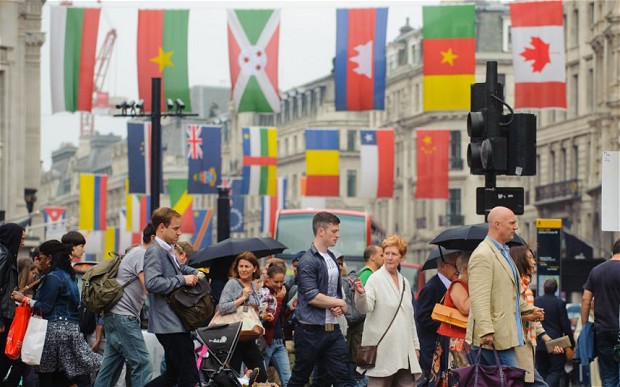
A Facebook friend sent a 'proud to be an Anglican' photo and urged me to share it.
I couldn’t.
In the past couple of weeks I have seriously debated whether I want to be an Anglican. This is premised largely on the primates meeting that saw fit to ‘suspend’ the American church for three years BUT the trigger to my personal disgust was Archbishop Welby’s apology to the lesbian, gay, bisexual and transgender (LGBT) people for the hurt the Church has caused them over the years.
https://www.youtube.com/watch?v=DlB_tp0bu0E

I know that for many of you that apology was a gracious personal touch and incidental to Welby’s successful sidestepping of what seemed an inevitable schism. Perhaps you feel I should be more outraged by the primate’s readiness to accommodate African provinces that support the criminalisation of homosexuality? (Including the death sentence.) Or maybe I should be questioning the authority of that primates’ meeting? (Others, far better positioned than I am, are already doing so.)
I’m not gay, but..
Let me first share my context. I am neither lesbian nor bi or transgender. I don’t have gay children or grandchildren. I do have many gay friends, ironically, most met through the Church. Several are priests in leadership positions, others have powerful ministries in the NGO sector. Still others are faithful worshippers.
I have for 20 years watched them, including bishops and deans, being hurt by the Church. I have limped alongside a gay priest suffering a nervous breakdown. I have watched grown men, married and in committed service to God, weep uncontrollably because they could no longer deny their sexuality. I have tried to comfort their bewildered wives and children in the wake of an inevitable divorce.
I’ve seen a faithful rector, who’d been in a long term relationship with the knowledge of his bishop, forced to leave the Church. This because a handful of parishioners complained when his long-time partner arranged a permanent job transfer to the same small town. After a decade in a committed relationship they wanted to be closer to each other.
Others continue to live and work under the threatening shadow of the Anglican ‘don’t ask don’t tell system’.
It’s cruel and sorry doesn’t cut it.
Not Anglican enough?
I’m hardly a died-in-the-wool Anglican. From the age of 17 to my 50th birthday I didn’t attend church and only began to do so because at that milestone age it seemed a good insurance policy.
 In my maturity I was attracted to the three pillars of Anglicanism – Scripture, reason and tradition. I really liked that I could question dogma without being excommunicated. Liberation Theology was an elixir to a former political activist.
 People like Desmond Tutu made me realise that, while the church could be weird, it was often wonderful. I loved its commitment to justice and gobsmacked by a call into priesthood.
A heady era
At the time we Anglicans in Southern Africa, invariably decades ahead of the Church in England, had reinterpreted our sacred texts to permit divorcees to remarry and repentance of apartheid. Women were being priested. We’d even bought into Climate Change at a time when cynics were decrying apocalyptic forebodings as hogwash. In the context of Africa, Southern Africa lead the way in combatting the stigma surrounding HIV and AIDS.
But..

As always, there was an elephant in the room. Ours was homosexuality.
Then, as now, gay and lesbian priests were ordained but expected to remain celibate. No, these are not men and woman called by God into religious communities where celibacy is part of the package. These are folk called to a priesthood that encourages marriage because people in a stable relationship are more effective as clergy. (It’s our one-upmanship on the Catholics and, theoretically diminishes the incidence of paedophilia).
Adding insult to injury is the traditional readiness of our hetero bishops to forgive clergy who are unfaithful to their wives. At pew level we counsel hetero adulterers but still offer them Communion.
We offer the sacrament of marriage to couples who have cohabited for years. And we’ve long accepted that it’s okay for mutually accepting heterosexual partners to be far more creative and adventurous than ‘the missionary position’. So why are we so hung up on how gay people find sexual pleasure? Why do we presume to know how they do this?
By the way, those dudes in Genesis 19, who surrounded Lot’s home and threatened to have sex with the two angels in the guise of visitors, weren’t gay. They were townsmen intent on sexual aggression in a conflict situation, what the United Nations defines as a war crime. The abomination was violence.
Parenting

Why do we presume gay people can’t be good parents? Many single folk, men and women, do a great job. Surely in this day and age we know better than to equate good parenting with a particular set of genitalia?
Not sorry, repentance
If the Anglican Church is genuinely sorry for the hurt it has caused over too many decades, sorry won’t cut it. It’s repentance we need. Surely sound theology is based on more than culture and supposition?
Welby equates the church to a rowing boat going in circles. It needs to invests in an authoritative map. There was no mention of our primates consulting with experts on sexuality although they are happy to quote scientific evidence in regard to Climate Change.

Enough said, I ache for parents like Desmond and Leah Tutu whose daughter Mpho recently married her lesbian partner. It’s not just LGBT people that are hurt by the Church. Those who love them are too.
I am proud of…
Michael Curry’s measured and loving response to the primate’s meeting.

http://ow.ly/XtR62
The American Presiding Bishop (archbishop) responded to the three-year suspension of the Episcopalian Church with amazing grace.
https://www.youtube.com/watch?v=DlB_tp0bu0E

I know that for many of you that apology was a gracious personal touch and incidental to Welby’s successful sidestepping of what seemed an inevitable schism. Perhaps you feel I should be more outraged by the primate’s readiness to accommodate African provinces that support the criminalisation of homosexuality? (Including the death sentence.) Or maybe I should be questioning the authority of that primates’ meeting? (Others, far better positioned than I am, are already doing so.)
I’m not gay, but..
Let me first share my context. I am neither lesbian nor bi or transgender. I don’t have gay children or grandchildren. I do have many gay friends, ironically, most met through the Church. Several are priests in leadership positions, others have powerful ministries in the NGO sector. Still others are faithful worshippers.
I have for 20 years watched them, including bishops and deans, being hurt by the Church. I have limped alongside a gay priest suffering a nervous breakdown. I have watched grown men, married and in committed service to God, weep uncontrollably because they could no longer deny their sexuality. I have tried to comfort their bewildered wives and children in the wake of an inevitable divorce.
I’ve seen a faithful rector, who’d been in a long term relationship with the knowledge of his bishop, forced to leave the Church. This because a handful of parishioners complained when his long-time partner arranged a permanent job transfer to the same small town. After a decade in a committed relationship they wanted to be closer to each other.
Others continue to live and work under the threatening shadow of the Anglican ‘don’t ask don’t tell system’.
It’s cruel and sorry doesn’t cut it.
Not Anglican enough?
I’m hardly a died-in-the-wool Anglican. From the age of 17 to my 50th birthday I didn’t attend church and only began to do so because at that milestone age it seemed a good insurance policy.
 In my maturity I was attracted to the three pillars of Anglicanism – Scripture, reason and tradition. I really liked that I could question dogma without being excommunicated. Liberation Theology was an elixir to a former political activist. People like Desmond Tutu made me realise that, while the church could be weird, it was often wonderful. I loved its commitment to justice and gobsmacked by a call into priesthood.
A heady era
At the time we Anglicans in Southern Africa, invariably decades ahead of the Church in England, had reinterpreted our sacred texts to permit divorcees to remarry and repentance of apartheid. Women were being priested. We’d even bought into Climate Change at a time when cynics were decrying apocalyptic forebodings as hogwash. In the context of Africa, Southern Africa lead the way in combatting the stigma surrounding HIV and AIDS.
But..

As always, there was an elephant in the room. Ours was homosexuality.
Then, as now, gay and lesbian priests were ordained but expected to remain celibate. No, these are not men and woman called by God into religious communities where celibacy is part of the package. These are folk called to a priesthood that encourages marriage because people in a stable relationship are more effective as clergy. (It’s our one-upmanship on the Catholics and, theoretically diminishes the incidence of paedophilia).
Adding insult to injury is the traditional readiness of our hetero bishops to forgive clergy who are unfaithful to their wives. At pew level we counsel hetero adulterers but still offer them Communion.
We offer the sacrament of marriage to couples who have cohabited for years. And we’ve long accepted that it’s okay for mutually accepting heterosexual partners to be far more creative and adventurous than ‘the missionary position’. So why are we so hung up on how gay people find sexual pleasure? Why do we presume to know how they do this?
By the way, those dudes in Genesis 19, who surrounded Lot’s home and threatened to have sex with the two angels in the guise of visitors, weren’t gay. They were townsmen intent on sexual aggression in a conflict situation, what the United Nations defines as a war crime. The abomination was violence.
Parenting

Why do we presume gay people can’t be good parents? Many single folk, men and women, do a great job. Surely in this day and age we know better than to equate good parenting with a particular set of genitalia?
Not sorry, repentance
If the Anglican Church is genuinely sorry for the hurt it has caused over too many decades, sorry won’t cut it. It’s repentance we need. Surely sound theology is based on more than culture and supposition?
Welby equates the church to a rowing boat going in circles. It needs to invests in an authoritative map. There was no mention of our primates consulting with experts on sexuality although they are happy to quote scientific evidence in regard to Climate Change.

Enough said, I ache for parents like Desmond and Leah Tutu whose daughter Mpho recently married her lesbian partner. It’s not just LGBT people that are hurt by the Church. Those who love them are too.
I am proud of…
Michael Curry’s measured and loving response to the primate’s meeting.

http://ow.ly/XtR62
The American Presiding Bishop (archbishop) responded to the three-year suspension of the Episcopalian Church with amazing grace.
To quote him: "I stand before you as your brother. I stand before you as a descendant of African slaves, stolen from their native land, enslaved in a bitter bondage, and then even after emancipation, segregated and excluded in church and society. And this conjures that up again, and brings pain. The pain for many will be real. But God is greater than anything. I love Jesus and I love the church. I am a Christian in the Anglican way. And like you, as we have said in this meeting, I am committed to 'walking together' with you as fellow Primates in the Anglican family."
As Ruth Gledhill, Contributing Editor for Christian Today, commented: “The holiness in him and in his words is tangible. It is a genuine turning of the other cheek. He is not threatening to walk away; he is pledging his Church to walk together with all the Primates of the Anglican Communion.
“It is his grace in the face of terrible rejection that shines out from this whole sorry episode. This grace and sacrifice is what has allowed the Archbishop of Canterbury to preserve the unity of the Anglican Communion.”
She speaks of the terrible price exacted from The Episcopal Church in the US and from LGBT communities around the world.
As Ruth Gledhill, Contributing Editor for Christian Today, commented: “The holiness in him and in his words is tangible. It is a genuine turning of the other cheek. He is not threatening to walk away; he is pledging his Church to walk together with all the Primates of the Anglican Communion.
“It is his grace in the face of terrible rejection that shines out from this whole sorry episode. This grace and sacrifice is what has allowed the Archbishop of Canterbury to preserve the unity of the Anglican Communion.”
She speaks of the terrible price exacted from The Episcopal Church in the US and from LGBT communities around the world.
I, in my anger and shame, am reminded by her of the need to focus on grace and the importance of finding a way forward.
One way could be parallel provinces of conservatives and liberals. Another possibility is a more federal model, similar to that of the Lutheran churches of northern Europe and Scandinavia.
Please God let Archbishop Welby, an expert in dispute resolution, find a way for the Communion to stop the hurt. We have to find a solution; we’ve been apologising for decades!
One way could be parallel provinces of conservatives and liberals. Another possibility is a more federal model, similar to that of the Lutheran churches of northern Europe and Scandinavia.
Please God let Archbishop Welby, an expert in dispute resolution, find a way for the Communion to stop the hurt. We have to find a solution; we’ve been apologising for decades!